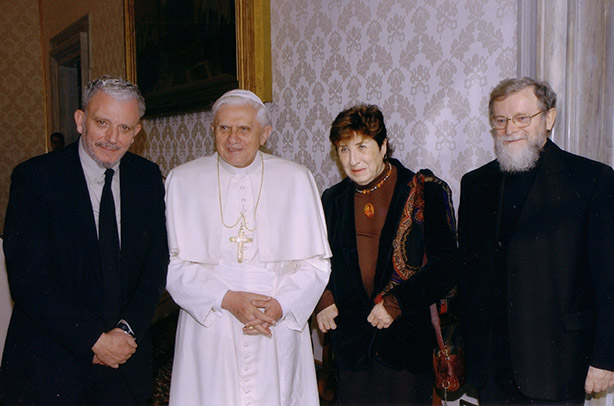
“What earlier generations held as sacred, remains sacred and great for us too, and it cannot be all of a sudden entirely forbidden or even considered harmful. ” Benedict XVI letter to Bishops July 7, 2007
Almost every Sunday my wife and I attend a Traditional Latin Mass (TLM), a Mass said according to the 1962 Roman Missal. It’s a valid and licit Mass celebrated by priests in full communion with the Pope, our local ordinary and their own religious superiors. We also often attend the “normal” Mass (“Novus Ordo”) at our parish too.
Once in a great while somebody will ask me, “Why do you like the Latin Mass?” To which I normally (and honestly) answer, “Because it’s a very reverent Mass.”
Now, if I am discussing the TLM with somebody whom I know already appreciates that Mass, the conversation almost always centers on the TLM’s emphasis on the sacrificial nature of the Eucharist and on the Real Presence of our Lord in the sacrament. These two emphases, of course, explain the reverence that I mentioned at first.
The Sacrifice
The Eucharist is a sacrifice because it re-presents (makes present) the sacrifice of the cross. (“Catechism of the Catholic Church.” 1364)
This post would be quite long if I cited every place in the TLM where this teaching was emphasized, so I will cite three such places, using the English translations found in my hand missal.
The Offertory
One good example of the TLM’s emphasis on the sacrificial nature of the Eucharist is in the priest’s prayers during the offertory:
Receive, O Holy Father, almighty and eternal God, this spotless host, which I, Thine unworthy servant, offer unto Thee, my living and true God, for my innumerable sins, offenses, and negligences, and for all here present; and also for all faithful Christians both living and dead, that it may profit me and them for salvation unto life everlasting. Amen…
We offer Thee, O Lord, the chalice of salvation, pleading Thy clemency, that it may ascend in the sight of Thy divine majesty, with a sweet fragrance, for our salvation and for that of the whole world. Amen. In a humble spirit and a contrite heart may we be received by Thee, O Lord, and let our sacrifice be so made in Thy sight this day that it may please Thee, O Lord God. Come, O sanctifier, almighty and eternal God, and bless this sacrifice prepared for Thy holy name…
Receive, O holy Trinity, this oblation which we offer to Thee in remembrance of the Passion, Resurrection, and Ascension of Our Lord Jesus Christ, and in honor of blessed Mary, ever Virgin, blessed John the Baptist, the holy Apostles Peter and Paul, and of these and of all the Saints; that it may avail unto their honor and our salvation, and may they deign to intercede in heaven for us who honor their memory here on earth. Through the same Christ, our Lord. Amen.
Priest: Pray brethren, that my sacrifice and yours may be acceptable to God the Father almighty.
Server: May the Lord receive the sacrifice from your hands, to the praise and glory of His name, to our benefit, and that of all His holy Church.
The Secret Prayer
The second example of the sacrificial emphasis of the TLM can be found in the “Oratio Secreta”, or Secret Prayer, which is a prayer recited by the celebrant in a low voice at the end of the Offertory. It is the original offertory prayer, and for a long time was the sole offertory prayer in the TLM. It is recited in a low voice because it was originally prayed while the choir was singing a psalm.
The Secret is part of the Proper of the Mass, meaning it changes for each feast or occasion. Here is an example from last Sunday, the Seventh Sunday after Pentecost in the traditional calendar:
O God, who hast justified the variety of sacrifices of the Law by the perfection of this one Sacrifice: accept the Sacrifice of Thy servants who are dedicated to Thee, and sanctify it with a blessing like to that which Thou didst bestow upon the gifts of Abel: that what each one of us has offered to the honor of Thy Majesty, may profit us all unto salvation. Through our Lord Jesus Christ, Thy Son, Who lives and reigns with Thee in the unity of the Holy Spirit, God, forever and ever.
The Canon
A third example of the TLM’s emphasis on the sacrificial nature of the Eucharist can be found in the Canon, or the prayer of consecration:
We therefore beseech Thee, O Lord, to graciously accept this oblation of our service, as also of Thy entire family; dispose our days in Thy peace, save us from eternal damnation, and command that we be numbered in the flock of Thine elect. Through Christ our Lord. Amen.
Which oblation, do Thou, O God, deign in all respects to make blessed, approved, ratified, reasonable and acceptable, so that it may become for us the Body and Blood of Thy most beloved Son, our Lord, Jesus Christ…
In like manner, after He had supped, taking also this excellent chalice into His holy and venerable hands, and giving thanks to Thee, He blessed it, and gave it to His disciples, saying: Take, all of you, and drink of this:
FOR THIS IS THE CHALICE OF MY BLOOD OF THE NEW AND ETERNAL TESTAMENT:
THE MYSTERY OF FAITH:
WHICH SHALL BE POURED OUT FOR YOU AND FOR MANY UNTO THE REMISSION OF SINS.
As often as you shall do these things, you do them in memory of Me.
The Real Presence
The TLM consistently reinforces the Church’s belief in the most blessed sacrament of the Eucharist “the body and blood, together with the soul and divinity, of our Lord Jesus Christ and, therefore, the whole Christ is truly, really, and substantially contained.” (“Catechism of the Catholic Church.” 1374)
Here are some of the many ways that the TLM emphasizes belief in the Real Presence: communicants kneel and receive Communion on the tongue, the many genuflections of the priest throughout the rite; the purification of the priest’s fingers over and in the chalice; the preservation of the priest’s fingers from all profane contact after the Consecration; the pall to protect the chalice; the use of altar stones and relics, even for portable altars; and the use of three altar cloths. (Cardinals Ottaviani and Bacci)
Lex orandi, lex credendi
According to an often cited poll conducted by the Pew Research Center, only one-third of Catholics in the U.S. (31%) say they believe that “during Catholic Mass, the bread and wine actually become the body and blood of Jesus.” 43% of American Catholics believe that the bread and wine are merely symbolic and that this reflects the position of the church. 22% of American Catholics reject the idea of transubstantiation, even though they know about the church’s teaching. (Smith)
This is troubling, and we should not only ask “Why?”, but also “What can we do about this?”
Since Pope Francis issued his motu proprio Traditionis Custodes in 2021, priests throughout the world have been greatly restricted in their ability to celebrate the TLM. However, the Church has long held to the principal of “Lex orandi, lex credendi“, meaning “the law of prayer is the law of belief”. In other words, the way Catholics worship and pray forms and shapes their beliefs. If that’s indeed true, then the Church reverse course by making ample provision for the Traditional Latin Mass.
Works Cited
Cardinals Ottaviani and Bacci. Latin Mass Society, Latin Mass Society, 25 Sept. 1969, https://lms.org.uk/ottaviani-intervention. Accessed 30 July 2025.
“Catechism of the Catholic Church.” The Holy See, https://www.vatican.va/archive/ENG0015/_INDEX.HTM. Accessed 30 July 2025.
“Letter to the Bishops that accompanies the Apostolic Letter “Motu Proprio data” Summorum Pontificum on the Roman liturgy prior to the reform of 1970 (July 7, 2007) | BENEDICT XVI.” The Holy See, 7 July 2007, https://www.vatican.va/content/benedict-xvi/en/letters/2007/documents/hf_ben-xvi_let_20070707_lettera-vescovi.html. Accessed 30 July 2025.
“Resources for the Traditional Latin Mass.” Extraordinary Form, Traditional Latin Mass, Tridentine Mass: Latin Mass Resources, https://extraordinaryform.org/. Accessed 30 July 2025.
Smith, Gregory A. “One-third of U.S. Catholics believe in transubstantiation.” Pew Research Center, 5 August 2019, https://www.pewresearch.org/short-reads/2019/08/05/transubstantiation-eucharist-u-s-catholics/. Accessed 30 July 2025.