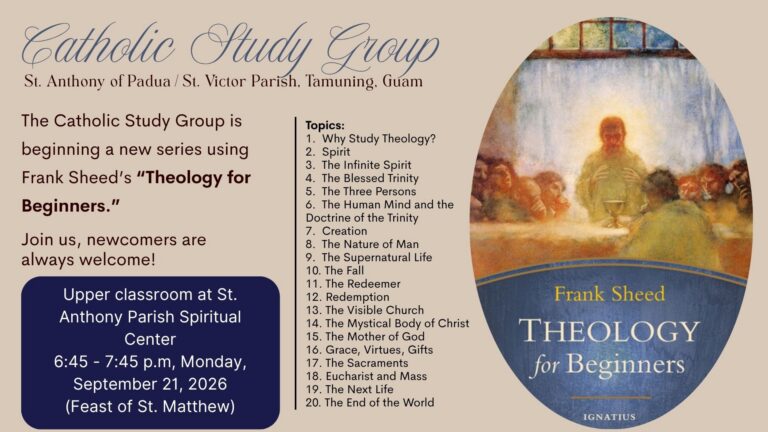
When discussing the Anointing of the Sick at one of our recent Catholic Study Group meetings, the text briefly mentioned “the Apostolic Pardon”. Have you heard of it? Neither had I.
What is it?
The Apostolic Pardon is a blessing with a plenary indulgence that is bestowed after the anointing of the sick and confession if the recipient is in danger of death. Confession forgives the eternal punishment for sin and the indulgence of the Apostolic Pardon remits the temporal punishment due to sin, i.e. penance and purgatory. (Grondin)
Our Sunday Visitor’s Catholic Encyclopedia tells us that it is included in the rite for emergencies:
The present ritual orders these sacraments in two ways. The ‘continuous rites of penance and anointing’ include: Introductory Rites, Liturgy of Penance, Liturgy of Confirmation, Liturgy of Anointing, Liturgy of Viaticum, and Concluding Rites. The ‘rite for emergencies’ includes the sacrament of penance, Apostolic Pardon, Lord’s Prayer, Communion as Viaticum, prayer before anointing, anointing, concluding prayer, blessing, sign of peace” (Shaw 601)
Form of the Apostolic Pardon
Currently, there are two forms of the Apostolic Pardon (or “Apostolic Blessing”)(McNamara):
- “By the authority which the Apostolic See has given me, I grant you a full pardon and the remission of all your sins in the name of the Father, and of the Son, + and of the Holy Spirit.” Latin: “Ego facultáte mihi ab Apostólica Sede tribúta, indulgéntiam plenáriam et remissiónem ómnium peccatórum tibi concédo, in nómine Patris, et Fílii, + et Spíritus Sancti. Amen“
- “Through the holy mysteries of our redemption, may almighty God release you from all punishments in this life and in the life to come. May He open to you the gates of paradise and welcome you to everlasting joy.” Latin: “Per sancrosáncta humánæ reparatiónis mystéria, remíttat tibi omnípotens Deus omnes præséntis et futúræ vitæ pœnas, paradísi portas apériat et ad gáudia te sempitérna perdúcat. Amen.“
Here is the older form of the Apostolic Pardon:
“By the Faculty which the Apostolic See has given me, I grant you a plenary indulgence and the remission of all your sins, and I bless you. In the Name of the Father and the Son + and the Holy Spirit. Amen.” Latin: “Ego facultate mihi ab Apostolica Sede tributa, indulgentiam plenariam et remissionem omnium peccatorum tibi concedo et benedico te. In nomine Patris, et Filii, + et Spirtus Sancti, Amen.“
History
These papal blessings and indulgences were first granted to the Crusaders or to pilgrims who died while traveling to obtain the Holy Year Indulgence. Pope Clement IV (1265-1268) and Gregory XI (1370-1378) extended it to victims of the plague. The grants became ever more frequent but were still limited in time or reserved to bishops, so that relatively few people were favored by this grace. This led Pope Benedict XIV (1740-1758) to issue the constitution “Pia Mater” in 1747 in which he granted the faculty to all bishops, along with the possibility to subdelegate the faculty to priests. (“Indulgences at the Point of Death”)
From the Enchiridion
The fourth edition of the Enchiridion Indulgentiarum(1999), the “Handbook of Indulgences”, describes this indulgence completely (“Enchiridion Indulgentiarum quarto editur”):
12 At the point of death
§ 1. A priest who administers the sacraments to a faithful Christian in danger of death should not fail to impart to him the apostolic blessing with the accompanying plenary indulgence .
§ 2. But if a priest cannot be found, pious Mother Church graciously grants to the same faithful Christian, duly disposed , a plenary indulgence to be acquired at the hour of death, provided that he has habitually offered some prayers during his life; in which case the Church supplies the three conditions normally required for a plenary indulgence.
§ 3. The crucifix or cross is commendably used to acquire this plenary indulgence.
§ 4. A faithful Christian will be able to obtain the same plenary indulgence at the moment of death, even if he has already acquired another plenary indulgence on the same day.
§ 5. The faithful should be informed in a timely and frequent manner about this salutary disposition of the Church in the teaching of catechesis.
Works Cited
“Enchiridion Indulgentiarum quarto editur.” The Holy See, https://www.vatican.va/roman_curia/tribunals/apost_penit/documents/rc_trib_appen_doc_20020826_enchiridion-indulgentiarum_lt.html. Accessed 20 July 2025.
Grondin, Charles. “The Apostolic Pardon.” Catholic Answers, https://www.catholic.com/qa/the-apostolic-pardon. Accessed 20 July 2025.
“Indulgences at the Point of Death.” EWTN, https://www.ewtn.com/catholicism/library/indulgences-at-the-point-of-death-4696. Accessed 20 July 2025.
“Plenary indulgences explained.” National Shrine of Mary, Mother of the Church, 13 January 2025, https://thenationalshrineofmarymotherofthechurch.com/plenary-indulgences-explained/. Accessed 20 July 2025.
Shaw, Russell B. Our Sunday Visitor’s Catholic Encyclopedia. Edited by Peter M.J. Stravinskas, Our Sunday Visitor, 1998.