
And we have the prophetic word made more sure. You will do well to pay attention to this as to a lamp shining in a dark place, until the day dawns and the morning star rises in your hearts. 2 Peter 1:19
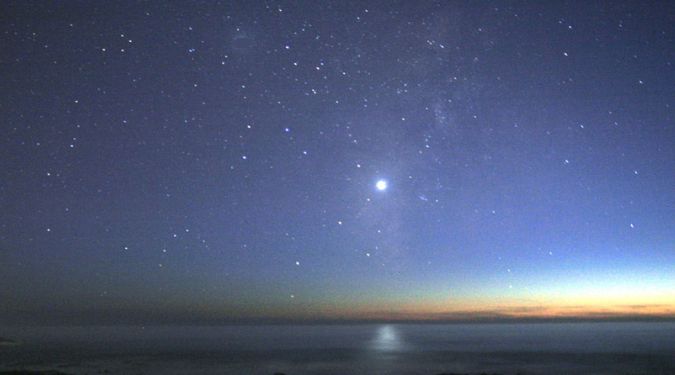
In the New Testament, the “Morning Star” is an image that is exclusively associated with Jesus Christ. In Catholic Tradition, however, it is a type that has been used with two other personages. The “star” itself is actually the planet Venus which is often seen in the early morning before dawn and in a sense heralds the dawn.
Our Lord identifies Himself with the morning star in the Book of Revelation:
“I Jesus have sent my angel to you with this testimony for the churches. I am the root and the offspring of David, the bright morning star.” Revelation 22:16
In the Gospel of St. Luke, we see Zechariah prophesying the Lord’s coming by using the figure of dawn:
through the tender mercy of our God, when the day shall dawn upon us from on high Luke 1:78
This figures of a star and of dawn spring from the Old Testament:
I see him, but not now; I behold him, but not nigh: a star shall come forth out of Jacob, and a scepter shall rise out of Israel; it shall crush the forehead of Moab, and break down all the sons of Sheth. Numbers 24:17
And:
Arise, shine; for your light has come, and the glory of the Lord has risen upon you. For behold, darkness shall cover the earth, and thick darkness the peoples; but the Lord will arise upon you, and his glory will be seen upon you. And nations shall come to your light, and kings to the brightness of your rising. Isaiah 60:1-3
The word St. Peter uses in 2 Peter 1:19 is “φωσφόρος” (“phosphoros”), which literally means “light bringing” and figuratively means “morning star.” (Thayer 668) This Greek word only appears only in 2 Peter.
The Book of Revelation uses a similar phrase in chapter 22: “Ἀστὴρ ὁ λαμπρός ὁ πρωϊνός (aster ho lampros ho proinos), “the bright star of the morning.”
The Book of Revelation uses another word, “εωσφορος” (“eosphoros”, bearer of dawn), in chapter 2:
and I will give him the morning star. Revelation 2:28
We also see this word, eosphoros, in the Septuagint’s text of Isaiah 14:12 where Isaiah ironically refers to the King of Babylon, Nebuchadnezzar:
“How you are fallen from heaven, O Day Star, son of Dawn! How you are cut down to the ground, you who laid the nations low! Isaiah 14:12
The Hebrew Masoretic text for this verse uses the word “הֵילֵל” (“heylel”, “shining one”, “morning star”), while the Latin Vulgate uses the word “lucifer” (“light bearer”):
Quomodo cecidisti de cælo lucifer, qui mane oriebaris? corruisti in terram, qui vulnerabas gentes? Isaiah 14:12
The word “lucifer” is not used anywhere else in the Vulgate. For example, in Revelation 2:28, the Vulgate uses the phrase “stellam matutinam”, and in Revelation (22:16) it uses the phrase “stella splendida.”
What about Lucifer?
So how can the image of the morning star be used for both our Lord and the devil?
St. Augustine, in his book, “City of God”, Book XI, Chapter 15, identifies the “lucifer” of Isaiah 14:12 as a type of the devil:
As for what John says about the devil, “The devil sinneth from the beginning,” they who suppose it is meant hereby that the devil was made with a sinful nature, misunderstand it; for if sin be natural, it is not sin at all. And how do they answer the prophetic proofs,—either what Isaiah says when he represents the devil under the person of the king of Babylon, “How art thou fallen, O Lucifer, son of the morning!”
In doing so, St. Augustine is agreeing with Origen of Alexandria, who, in his work “De Principiis” (215 AD), was the first to see the “lucifer” of Isaiah 14:12 as a type of the devil (Origen bk. 1, ch. 5):
5. Again, we are taught as follows by the prophet Isaiah regarding another opposing power. The prophet says, How is Lucifer, who used to arise in the morning, fallen from heaven! He who assailed all nations is broken and beaten to the ground. You indeed said in your heart, I shall ascend into heaven; above the stars of heaven shall I place my throne; I shall sit upon a lofty mountain, above the lofty mountains which are towards the north; I shall ascend above the clouds; I shall be like the Most High. Now shall you be brought down to the lower world, and to the foundations of the earth.
St. Thomas Aquinas, writing in the 13th century commentary on the Book of Isaiah, agrees with Origen and St. Augustine in assigning the “lucifer” In Isaiah 14:12 as a type of the devil:
Second, they reproach him with the glory he has lost. Both as to the dignity of the king: O Lucifer, beautiful among all other kings, in the morning, monarch before all others; and as to the power of war: how are you fallen to the earth: you, therefore, are the head of gold. And after you shall rise up another kingdom, inferior to you (Dan 2:38–39).
When thinking of the devil, we can gain some benefit by remembering what “lucifer” really means and recalling that the title was ironically assigned to him as one who “purports to be the light bearer.”
What about Mary?
St. Pope John Paul II, in his 1987 encyclical, Redemptoris Mater, seems to have been the first to associated the morning star (“stella matutina”) with the Blessed Virgin Mary.
Therefore, if to that ancient historical expectation of the Savior we compare these years which are bringing us closer to the end of the second Millennium after Christ and to the beginning of the third, it becomes fully comprehensible that in this present period we wish to turn in a special way to her, the one who in the “night” of the Advent expectation began to shine like a true “Morning Star” (Stella Matutina). For just as this star, together with the “dawn,” precedes the rising of the sun, so Mary from the time of her Immaculate Conception preceded the coming of the Savior, the rising of the “Sun of Justice” in the history of the human race. (Redemptoris Mater, sec. 3)
Conclusion
The title “Morning Star” is assigned to Our Lord in the New Testament and is ironically assigned to the devil, through a type seen in the Book of the Prophet Isaiah. St. Pope John Paul II assigns it as a title of Our Lady, but only in a way the heralds the coming of Our Lord by using another type, the Sun of Justice (Malachi 4;2).
Works Cited
Aquinas, Thomas. Exposition of the Prophet Isaiah. Translated by the Aquinas Institute, Aquinas.cc, https://aquinas.cc/la/en/~Isaiah.C14.n413.6. Accessed 27 Apr. 2026.
Augustine. City of God (Book XI). Translated by Marcus Dods, New Advent, edited by Kevin Knight, https://www.newadvent.org/fathers/120111.htm. Accessed 27 Apr. 2026.
Origen. De Principiis (Book I). Translated by Frederick Crombie, New Advent, edited by Kevin Knight, www.newadvent.org/fathers/0412.htm. Accessed 27 Apr. 2026.
Propheta Isaias. SacredBible.org, 2010, www.sacredbible.org/vulgate1914/VT-27_Isaias.htm#14.
Thayer, Joseph Henry, et al. Thayer’s Greek-English Lexicon of the New Testament: Coded with the Numbering System from Strong’s Exhaustive Concordance of the Bible. Edited by Joseph Henry Thayer, translated by Joseph Henry Thayer, Hendrickson, 1996.