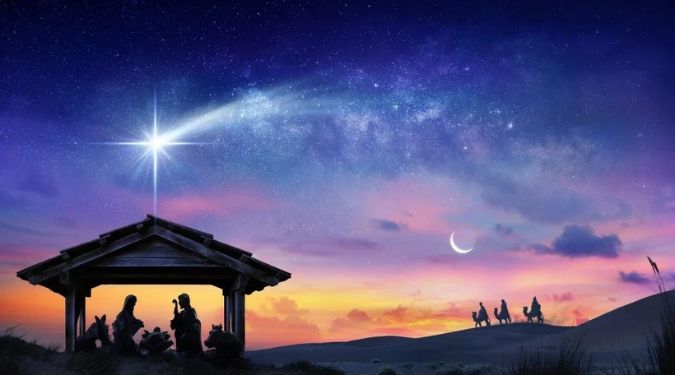

Here’s a short podcast I recorded on the Magi, the Star of Bethlehem and an ancient prophecy that circulated among the gentiles from long before Jesus was born.
In this episode we’ll talk about the Magi and the Star of Bethlehem and an ancient prophecy that circulated among the gentiles from long before Jesus was born.
—————————————–
When Jesus was born in Bethlehem of Judea, in the days of King Herod, behold, magi from the east arrived in Jerusalem, saying, “Where is the newborn king of the Jews? We saw his star at its rising and have come to do him homage.” Matthew 2:1-2 NABRE
The Magi
Who were these Magi? “Magi” could refer to any one of four possibilities. They could be:
- Members of the Persian priestly caste and philosophers, or
- Possessors and users of supernatural knowledge and ability, or
- Magicians, or
- Deceivers and seducers
In his book, “Jesus of Nazareth – The Infancy Narratives,” Pope Benedict identifies the Magi mentioned by Matthew to be in the first category.
The Star itself
In the seventeenth century Johannes Kepler († 1630) calculated that in the year 7–6 B.C., which approximately when Jesus was born, there was a conjunction of the planets Jupiter, Saturn and Mars.
Where could these pagan, gentile, Magi have heard about the star the coming King of the Jews?
Balaam
In the same book Pope Benedict XVI says this about the story of the Magi and the star in the Gospel of Mattew,
Another passage …is a saying attributed in the Bible to the pagan prophet Balaam. Balaam is a historical figure, for whom there is extra biblical confirmation. In 1967, on the East Bank of the Jordan, an inscription was discovered in which Balaam, son of Beor, is named as a “seer” of autochthonous (indigenous) deities: various oracles, both of doom and salvation, are ascribed to him.
The inscription mentioned by Pope Benedict was found at Tell Deir Alla (in modern Jordan) and it dates back to the eighth century B.C.
Balaam’s Four Prophecies
This Old Testament passage mentioned by Pope Benedict is found in Numbers, chapter 24, in an oracle given by the gentile Balaam, The story of Balaam begins in chapter 22 of the book of Numbers and stretches for three whole chapters.
The Isrealites have arrived on the doorstep of the Promised Land and have just defeated the Amorites and King Og and Bashan. They are on the edge of the land of Moab, and the King of Moab, Balak, sees them and is frightened. He attempts to hire the pagan soothsayer, Balaam, to curse the Israelites. To make a long story short, Balaam attempts to curse the Israelites four times, but, through the sovereign action of God, ends up blessing them four times instead.
- Numbers 23:7ff Israel is set apart from the other nations and holy.
- Numbers 23:18ff Israel is faithful and free from idolatry and divination
- Numbers 24:2ff Israel is prosperous and fruitful
- Numbers 24:15ff Israel will be victorious
Israel is described in the soaring poetry of these oracles as God sees Israel and as God intends them to be and to become.
Prophecy of the Star
It’s in the fourth and final blessing that the prophecy mentioned by Pope Benedict is heard:
“I see him, but not now; I behold him, but not nigh: a star shall come forth out of Jacob, and a scepter shall rise out of Israel; it shall crush the forehead of Moab, and break down all the sons of Sheth.” Numbers 24:17
Stars were often associated with Kings in those days. This prophecy could also point to King David too, but that’s okay because the Sacred Scriptures, like a fine gem, has multiple facets or layers.
Eusebius, a bishop of Cesarea and Church historian early in the 4th century wrote this about the Magi and Balaam’s prediction:
We are told that Balaam’s successors moved by this (for the prediction was preserved most likely among them) when they noticed in the heavens a strange star besides the usual ones, fixed above the head, so to say, and vertically above Judea, hastened to arrive at Palestine, to inquire about the king announced by the star’s appearance.” – Eusebius of Caesarea: Demonstratio Evangelica (Proof of the Gospel) , Book 9, Chapter 1, before AD 311
Balaam’s Sin
Balaam was a soothsayer for hire, and the biblical narrative makes it clear that it is God alone who can take credit for the blessings and prophecy of Balaam.
Speaking of the Moabites, Nehemiah says:
for they did not meet the Israelites with food and water, but they hired Balaam to curse them, though our God turned the curse into a blessing.” Nehemiah 13:2
Things did not end well for Balaam. We read in the book of Revelation:
Yet I have a few things against you. You have some people there who hold to the teaching of Balaam, who instructed Balak to put a stumbling block before the Israelites: to eat food sacrificed to idols and to play the harlot. Revelation 2:14
You see, later on, Balaam convinced the King of Moab to have the Moabite women seduce the Israelite men which resulted in the men sacrificing the Moabite god Baal.
In the book of Joshua we read:
Balaam, son of Beor, the diviner, the Israelites killed with the sword, together with those they struck down. Joshua 13:22
So if the speculations of Eusebius of Cesarea and Pope Benedict are correct, the Magi were motivated by the ancient prophecy of the unwilling gentile Balaam which circulated in the society in which they lived.
Summary
What are the takeaways from this story of the Magi, the Star, and Balaam?
- We’re thankful to God for revealing Himself to the pagan gentiles and for including the gentiles in His Plan for redeeming us.
- God calls pagans to Himself.
- God in His Sovereignty can work through pagans.
- Lastly, a word of caution. We must be careful. Our “dialog” with the pagan world may in reality be deadly flirtation.
Father, you revealed your Son to the nations by the guidance of a star. Lead us to your glory in heaven by the light of faith. We ask this through our Lord Jesus Christ, your Son, who lives and reigns with you in the unity of the Holy Spirit, God, for ever and ever. Amen.