
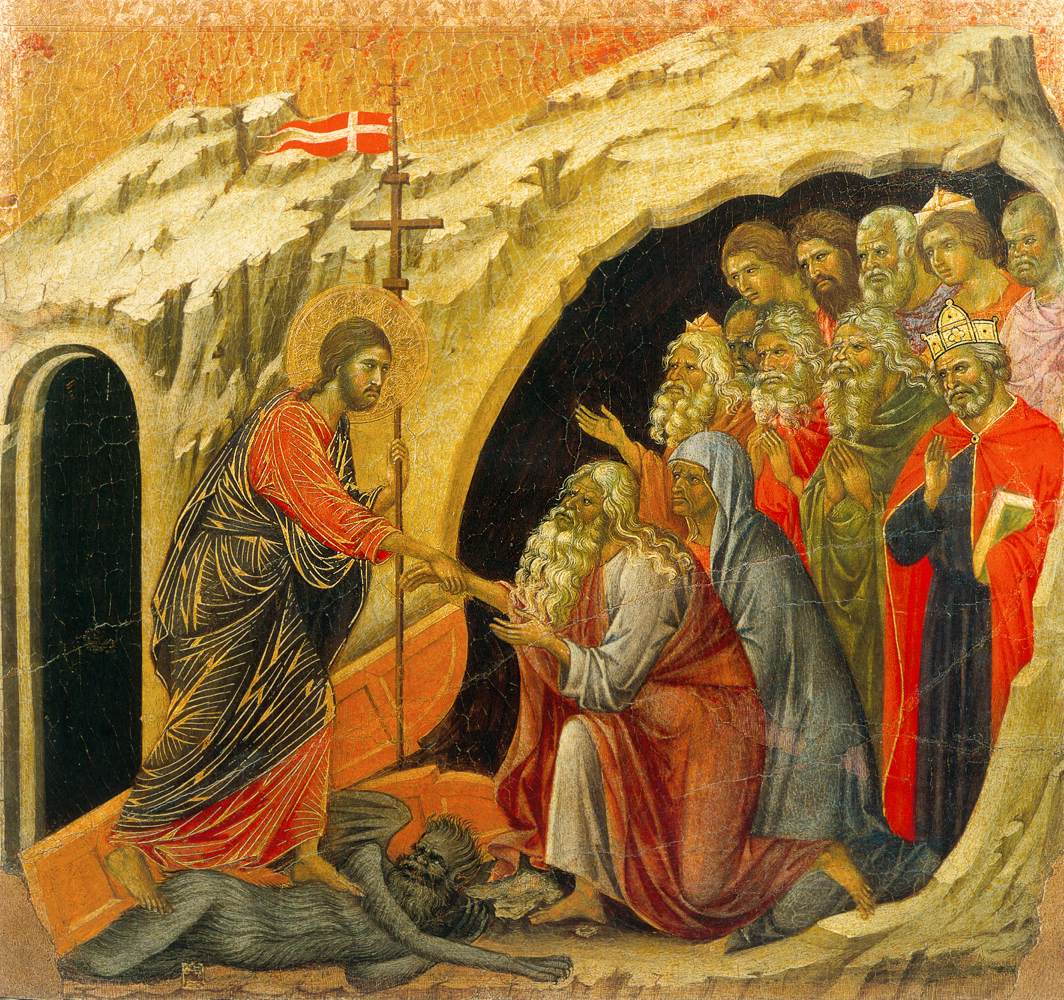

A few days after reading the ancient homily on Our Lord’s descent into hell on Holy Saturday, I happened upon this verse in the First Letter of Peter:
For this is why the gospel was preached even to the dead, that though judged in the flesh like men, they might live in the spirit like God. 1 Peter 4:6
The Church has long held that this verse supports the first part of the fifth article of the Apostles’ Creed: “he descended into hell; on the third day he rose again from the dead.” It has traditionally called His descent into hell “the Harrowing of Hell.”
An archaic definition of the verb “harrow” is to “rob, pillage, plunder,” and while the Catechism of the Catholic Church does not use words like this when describing Our Lord’s descent into hell, St. Thomas Aquinas and the Roman Catechism do. Let’s consult them to find out more.
To Where Did He Descend?
In its section on Article V of the Apostles’ Creed, the Roman Catechism teaches (McHugh and Callan):
Hell, then, here signifies those secret abodes in which are detained the souls that have not obtained the happiness of heaven.
In the same section, the Roman Catechism identifies three such abodes:
- Hell proper, that “most loathsome and dark prison in which the souls of the damned are tormented with the unclean spirits in eternal and inextinguishable fire”
- Purgatory, “in which the souls of just men are cleansed by a temporary punishment, in order to be admitted into their eternal country, into which nothing defiled entereth”
- and a third place described as: “… that into which the souls of the just before the coming of Christ the Lord, were received, and where, without experiencing any sort of pain, but supported by the blessed hope of redemption, they enjoyed peaceful repose.” This abode is called the “Limbo of the Fathers”, or “Limbus Patrum.” (Schneider 61; Haydock)
Why Did He Go There?
While the Catechism of the Catholic Church covers this topic in sections 632 through 637, St. Thomas Aquinas, in his Expositio in Symbolum Apostolorum, answers this question most succinctly while conveying the full drama of the event. He proposes four reasons for Our Lord’s descent into hell. In his own words:
First, He wished to take upon Himself the entire punishment for our sin, and thus atone for its entire guilt. The punishment for the sin of man was not alone death of the body, but there was also a punishment of the soul, since the soul had its share in sin; and it was punished by being deprived of the beatific vision; and as yet no atonement had been offered whereby this punishment would be taken away. Therefore, before the coming of Christ all men, even the holy fathers after their death, descended into the underworld. Accordingly in order to take upon Himself most perfectly the punishment due to sinners, Christ not only suffered death, but also His soul descended to the underworld
The second reason is that He might perfectly deliver all His friends. Christ had His friends both in the world and in the underworld. The former were His friends in that they possessed charity; and the latter were they who departed this life with charity and faith in the future Redeemer, such as Abraham, Isaac, Jacob, Moses, David, and other just and good men. Therefore, since Christ had dwelt among His friends in this world and had delivered them by His death, so He wished to visit His friends who were detained in the underworld and deliver them also: “I will penetrate all the lower parts of the earth, and will behold all that hope in the Lord” [Sir 24:45].
The third reason is that He would completely triumph over the devil. Now, a person is perfectly vanquished when he is not only overcome in conflict, but also when the assault is carried into his very home, and the seat of his kingdom is taken away from him. Thus Christ triumphed over the devil, and on the Cross He completely vanquished him: “Now is the judgment of this world; now shall the prince of this world (that is, the devil) be cast out” [Jn 12:31]. To make this triumph complete, Christ wished to deprive the devil of the seat of his kingdom and to imprison him in his own house—which is the underworld. Christ, therefore, descended there, and despoiled the devil of everything and bound him, taking away his prey: “And despoiling the principalities and powers, He hath exposed them confidently in open show, triumphing over them in Himself” [Col 2:15]. Likewise, Christ who had received the power and possession of heaven and earth, desired too the possession of the underworld, as says the Apostle: “That in the name of Jesus every knee should bow, of those that are in heaven, on earth, and under the earth” [Phil 2:10]. “In My name they shall cast out devils” [Mk 16:17].
The fourth and final reason is that Christ might free the just who were in the underworld. For as Christ wished to suffer death to deliver the living from death, so also He would descend into the underworld to deliver those who were there: “You also by the blood of your testament, sent forth your prisoners out of the pit where there is no water” [Zech 9:11]. And again: “O death, I will be your death; O hell, I will be your bite” [Hosea 13:14]. Although Christ wholly overcame death, yet not so completely did He destroy the underworld, but, as it were, He bit it. He did not free all from the underworld, but those only who were without mortal sin.
When St. Thomas uses the word “despoil” as in Our Lord “despoiled the devil,” he is using a synonym of the word “harrow” and he is quoting from St. Paul:
And despoiling the principalities and powers, he hath exposed them confidently in open shew, triumphing over them in himself. Colossians 2:15 DRA
Works Cited
Aquinas, Thomas. Expositio in Symbolum Apostolorum. Translated by Nicholas Ayerst, Isidore.co, isidore.co/aquinas/Creed.htm. Accessed 10 Apr. 2024.
Aquinas, St. Thomas. The Catechetical Instructions of St. Thomas Aquinas. Translated by Joseph B. Collins, S.S., D.D., PhD., Introduction by Rudolph Bandas, PhD., S.T.D. et M., New York, Joseph F. Wagner, Inc., 1939.
Catechism of the Catholic Church: Complete and Updated. Crown Publishing Group, 1995.
Hahn, Scott, and Curtis Mitch, editors. Ignatius Catholic Study Bible: Old and New Testament. Ignatius Press, 2026.
“Harrow.” Webster’s Third New International Dictionary of the English Language Unabridged, 1993.
Haydock, George Leo. “1 Peter 3.” Haydock Catholic Bible Commentary on the New Testament, Wildfire Fellowship, Inc., 1999-2023, www.ecatholic2000.com/haydock/ntcomment247.shtml.
“Harrowing.” Wiktionary, 21 Feb. 2026, en.wiktionary.org/wiki/harrowing.
McHugh, O.P., John A., and Charles J. Callan, O.P., translators. Catechism of the Council of Trent. Charlotte, North Carolina, TAN Books, 2009.
Schneider, Athanasius. Credo: Compendium of the Catholic Faith. Sophia Institute Press, 2023.



Mr. White, can you please contact me?
God bless.
-Michael