

Why have modern translations of the Bible removed a verse traditionally held to be part of the inspired Sacred Scriptures?
If one reads the 7th and 8th verses in the fifth chapter of the first letter of St. John from an old English translation of the Bible, such as the King James Version or the Challoner Revision of the Douay Rheims Bible, one sees:
And there are Three who give testimony in heaven, the Father, the Word, and the Holy Ghost. And these three are one. And there are three that give testimony on earth: the spirit and the water and the blood. And these three are one. 1 John 5:7-8 Challoner Douay-Rheims
The same verses in the Clementine Vulgate are:
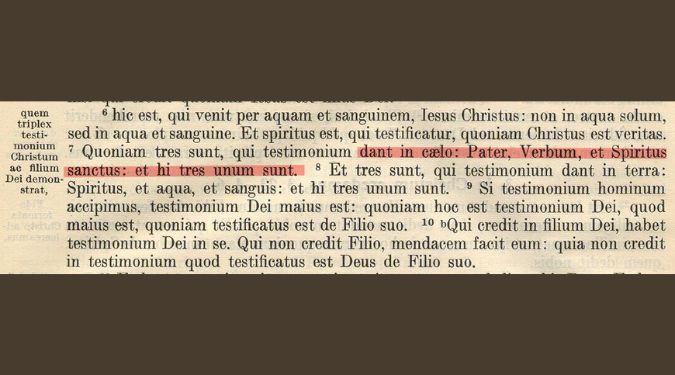
Quoniam tres sunt, qui testimonium dant in cælo: Pater, Verbum, et Spiritus sanctus: et hi tres unum sunt. Et tres sunt, qui testimonium dant in terra: Spiritus, et aqua, et sanguis: et hi tres unum sunt. 1 John 5:7-8 Clementine Vulgate
Newer translations of the New Testament, however, have removed some of the words traditionally held to be in those verses. For example:
So there are three that testify, the Spirit, the water, and the blood, and the three are of one accord. 1 John 5:7-8 NABRE
The missing words, called “the Johannine Comma” or the “Comma Johanneum” are, “in heaven, the Father, the Word, and the Holy Ghost. And these three are one. And there are three that give testimony on earth”. In Latin, they are “dant in cælo: Pater, Verbum, et Spiritus sanctus: et hi tres unum sunt. Et tres sunt, qui testimonium dant in terra”.
Why has it been removed from modern translations?
The Johannine Comma is found in a handful of late Greek manuscripts, along with a few medieval Vulgate manuscripts and the Clementine Vulgate of 1592. (Hahn, Ph.D. and Mitch, M.A. 2224) It cannot be found in any New Testament manuscripts prior to the end of the 4th century and more manuscripts of the Latin Vulgate prior to AD 1200 lack it than have it. It does not appear in any extant copies of the Vulgate prior to AD 800. (Vawter, C.M. 411) The first two Greek translations of the New Testament produced by the scholar Erasmus lacked the Johannine Comma although he did include it into the 3rd edition of his Greek New Testament from the Vulgate (1522). It then found its way into the Textus Receptus (1633) and consequently into the King James Version and the Rheims translation of the New Testament. (Perkins 993)
Most significantly, however, the Johannine Comma was not quoted by any of the Church Fathers during the Trinitarian controversies of the early Church, e.g. at the Councils of Nicaea (AD 325), Constantinople (AD 381), Ephesus (AD 431), Chalcedon (AD 451) or later councils. It is not present in any of the ancient manuscripts of the New Testament other than Latin, including the Syriac, Coptic, Armenian, Ethiopic, Arabic and Slavonic.
What is its origin?
The Johannine Comma might have originally been a gloss in an old Latin version of the New Testament that could have arisen as a margin note to the verses verse 7-8 regarding a Trinitarian interpretation of the verses. This gloss then could have made its way into the text itself through a scribal error. (Hahn, Ph.D. and Mitch, M.A. 2224)
A Trinitarian interpretation of the original verses of 1 John 5:7-8 appear in the writings of St. Cyprian of Carthage (A.D. 251) and St. Augustine of Hippo (A.D. 427). In St. Cyprian’s “De ecclesiae catholicae unitate” (“On the Unity of the Catholic Church §6”), (A.D. 251) we read:
The Lord says, “I and the Father are one;” and again it is written of the Father, and of the Son, and of the Holy Spirit, “And these three are one.” (Blakeney 19)
Notice that St. Cyprian does not quote 1 John 5:7-8 with the Johannine Comma but certainly would have done so if he was convinced that the phrase appeared in those verses.
St. Augustine also provides a Trinitarian interpretation of the verses In his work, Contra Maximinum, book 2, chapter 22 §. 3 (A.D. 427). But again, he does so without the help of the Johannine Comma, which he certainly would have employed if he knew it to be included in St. John’s letter. (Perkins 993)
The earliest witness to the text in Latin is by Priscillian of Avila (ca. AD 380) or his disciple Instantius in a work entitled Liber Apologeticus. (Metzger 717)
What has the Church said?
On January 13, 1897, the Holy Office (now known as the Dicastery for the Doctrine of the Faith) issued this decree:
To the question: “Whether it can safely be denied, or at least called into doubt that the text of St. John in the first epistle, chapter 5, verse 7, is authentic, which read as follows: ‘And there are three that give testimony in heaven, the Father, the Word, and the Holy Ghost. And these three are one?’ “—the response was given on January 13, 1897: In the negative.
At this point, the faithful could not deny or cast into doubt that the text of the Johannine Comma belonged in the First Letter of John.
Thirty years later, on June 2, 1927, the same Holy Office “walked back” this decree quite a bit:
“This decree was passed to check the audacity of private teachers who attributed to themselves the right either of rejecting entirely the authenticity of the Johannine comma, or at least of calling it into question by their own final judgment. But it was not meant at all to prevent Catholic writers from investigating the subject more fully and, after weighing the arguments accurately on both sides, with that and temperance which the gravity of the subject requires, from inclining toward an opinion in opposition to its authenticity, provided they professed that they were ready to abide by the judgment of the Church, to which the duty was delegated by Jesus Christ not only of interpreting Holy Scripture but also of guarding it faithfully.” (Denzinger 569-570)
Catholic writers were then allowed to express their opposition to the authenticity of the Johannine Comma, provided that they would abide by any future judgment of the Church on the matter.
That future judgment came in 1979 with the promulgation of the Nova Vulgata (New Vulgate) by St. Pope John Paul II:
“…the old text of the Vulgate edition was taken into consideration word for word, namely, whenever the original texts are accurately rendered, such as they are found in modern critical editions; however the text was prudently improved, whenever it departs from them or interprets them less correctly. For this reason Christian biblical Latinity was used so that a just evaluation of tradition might be properly combined with the legitimate demands of critical science prevailing in these times.“ (Scripturarum Thesaurus | St. John Paul II)
In the promulgation of the Nova Vulgata, the Church ruled, at least implicitly, on the Johannine Comma by removing it from the text:
Quia tres sunt, qui testificantur: Spiritus et aqua et sanguis; et hi tres in unum sunt. 1 John 5:7-8 Nova Vulgata
Works Cited
Nova Vulgata – Bibliorum Sacrorum Editio, The Holy See, https://www.vatican.va/archive/bible/nova_vulgata/documents/nova-vulgata_index_lt.html. Accessed 22 February 2025.
Blakeney, E. H., translator. Cyprian De unitate ecclesiae. New York, The Macmillan Co., 1928.
Denzinger, Heinrich. The Sources of Catholic Dogma. Translated by Roy Joseph Deferrari, Loreto Publications, 2001.
Hahn, Ph.D., Scott, and Curtis J. Mitch, M.A., editors. The Ignatius Catholic Study Bible. San Francisco, Ignatius Press, 2024.
Metzger, Bruce M. A Textual Commentary on the Greek New Testament. London, United Bible Societies, 1971.
Perkins, Pheme. “The Johannine Epistles.” The New Jerome Biblical Commentary, edited by Raymond Edward Brown, et al., Prentice-Hall, 1990, pp. 986-995.
Scripurarum Thesaurus | St. John Paul II. Apostolic Constitution. 25 April 1979, Rome. The Holy See, https://www.vatican.va/content/john-paul-ii/en/apost_constitutions/documents/hf_jp-ii_apc_19790425_scripturarum-thesaurus.html. Accessed 14 December 2024.
Vawter, C.M., Bruce. “The Johannine Epistles.” The Jerome Biblical Commentary, edited by Raymond E. Brown, S.S., et al., Prentice-Hall, Inc., 1968, pp. 404-413.


Hi. Unfortunately I hope you understand the Traditional Catholic Position on this verse.
1. The 1582 Rheims New Testament (Annotated): “7. (Three which giue testimonie.) An expresse place for the distinction of three persons, & the vnitie of nature and essence in the B. Trinitie: against the Arians and other like Heretikes, who haue in diuers ages found them selues so pressed with these plaine Scriptures, that they haue (as it is thought) altered and corrupted the text both in Greeke and Latin many waies: euen as the Protestants handle those textes that make against them. But because we are not now troubled with Arianisme so much as with Caluinisme, we neede not stand vpon the varietie of readings or expositions of this passage. See S. Hierom in his epistle put before the 7 Canonical or Catholike Epistles.” 2. Fr. Jakub Wujek Annotation to his Translation of the Bible (Translated from Polish): “The [Non Trinitarian] Anabaptists cast doubt on this whole verse, saying that it was not in the old Greek books, because some ancient writers do not mention it. But for us, more important is the testimony of the universal Church, which openly reads these words at the altar on Low Sunday (Dominica in Albis). This same passage is cited by St. Cyprian, in De Unitate Ecclesiae; Athanasius in Book 1 to Theophilus and also in his disputation with Arius at the Council of Nicaea; Pope Hyginus in his first letter; Pope John II in his letter to Valerius; St. Jerome in the prologue to the Canonical Epistles; Idacius in his book against Varimundus; Eugenius of Carthage as cited by Victor in Book 2 of the Vandal Persecution; and Fulgentius in Contra Objectiones Arianorum. Thus, we have the clear Word of God against the Arians and Samosatenes, about the distinction of the three divine Persons and their unity in divinity and nature: that the Father, the Son, and the Holy Ghost are three Persons, and yet one God.”
3. Fr. Cornelius a Lapide: “S. Jerome (Pref. in Epist. Canon.) observes that this verse had been erased by unbelievers, i.e. the Arians, from some Greek copies. Therefore it is not found in the Syriac, Clement of Alexandria, Bede, åcumenius, and some others. It is, however, the constant reading of the Latin Bibles, and the more correct Greek MSS. and of many of the ancients, SS. Athanasius, Augustine, Jerome, Cyprian, the Lateran Council, at which Greeks were present. Therefore it is certain that these words are to be taken as canonical Scripture.”
4. Bishop Torres Amat: The Arians omitted in some manuscripts this clear and explicit testimony to the Divinity of Jesus Christ and the Trinity of the divine Persons. Thus, some heretics have sought to impugn the legitimacy of this text, alleging some manuscript in which it is missing. However, nothing proves against the universal judgment of the Holy Fathers and writers of the early centuries of the Church, who either quote it with the very same words or clearly refer to them.
Besides Saint Cyprian, Tertullian, Saint Athanasius, etc., our Spanish author—namely Victorinus, in the books Ad Aliriodum, and Etherius and Beatus against Elipandus—literally cite it; and it is seen in the liturgical books of our Mozarabic Church, no less than in the very ancient manuscripts of various Churches that Cardinal Cisneros consulted for the Complutensian Polyglot edition of the Bible. Many other proofs can be found in the Dissertation appended to Carriéres’ Bible.
5. Robert Witham: “The Socinians object that this verse is wanting in many Greek manuscripts; and even Erasmus in one edition, and Mr. Simon in his Critics, have questioned it, or rejected it, as a false reading, but without any sufficient proofs and grounds, as hath been shewn by many learned Catholics, and also by Protestant writers, who receive in their translations this verse as canonical. It is easy to account for the omission of this verse; for as both the seventh and eighth verse begin and end with the same words, this gave occasion to the oversight and omission of the transcribers, whereas it is not credible that such a whole verse could be added. And that it was only by the mistake and oversight of transcribers may further appear, because we find part of the seventh verse, to wit, and these three are one, cited by Tertullian, lib. contra Praxeam. chap. xxiii. p. 515. Ed. Rig. and twice by St. Cyprian, Epist. 73. ad Jubaianum. p. 125. Ed. Rig. in the Oxford Edition, p. 310. and in his Treatise de Unit. Ecclesiĉ, p. 181. Ed. Rigal. and in the Oxford Ed. p. 79, where also Dr. Fell defends this verse of St. John to be genuine. Tertullian and St. Cyprian wrote long before the dispute with the Arians. The Socinians also object that this passage is not brought by St. Athanasius and some other fathers against the Arians, which they could scarce have omitted had they read this verse, but this only proves that this omission had happened in some manuscripts in their time, or, as some conjecture, that the Arians had corrupted some copies. St. Fulgentius made use of it against the Arians, and also others about that time. See the Benedictines of St. Maur against Mr. Simon, in the first tome of St. Jerome, p. 1670. Both Catholics and Protestants, after a diligent examination, have received this verse, which is found in the best manuscripts. See Greek Testament at Amsterdam, in the year 1711.[A.D. 1711.]”
In this article you’re saying that they’re wrong and You’re right. That’s not Catholic, just because Modernist Scholars have thrown this verse into the Trash doesn’t mean you to have to do that. To appeal to Manuscripts alone isn’t Catholic but Protestant. You scream “The Church Gave us the Bible” yet you deny this verse even if it has been read on Low Sunday and defended by Catholic Scholars.
I’ll take the position of St. John Paul II on this verse for the reasons I gave against a “sola scriptura” approach to the Vulgate.
As I mention in the article, the Johannine Comma was not quoted by any of the Church Fathers during the Trinitarian controversies of the early Church, e.g. at the Councils of Nicaea (AD 325), Constantinople (AD 381), Ephesus (AD 431), or Chalcedon (AD 451). The earliest instance of it that we can find in Latin is from around 385AD.
“St. Augustine also provides a Trinitarian interpretation of the verses In his work, Contra Maximinum, book 2, chapter 22 §. 3 (A.D. 427). But again, he does so without the help of the Johannine Comma, which he certainly would have employed if he knew it to be included in St. John’s letter. (Perkins 993)”
I’d suggest looking at what Father Cornelius a Lapide says about Saint Augustine:
“Three (tres in the masc.) He might have said tria in the neuter, for the Greek πνεῦμα, ὕδως, αἷμα, are all in that gender. But he chose to say tres, to show that these three earthly witnesses concur with, yea represent, the Three Heavenly witnesses already spoken of. So says S. Augustine. By a figure of speech, personality is attributed to these earthly witnesses, as speaking with man’s voice. S. John sets the human and earthly testimony over against the Divine…S. Augustine upon this passage thinks that by these three earthly witnesses the Three Persons of the Holy Trinity are denoted, viz., the Father by the spirit, the Son by the blood, the Holy Ghost by the water. For of the Father it is said, “God is a Spirit” (Jno. 4:14), the Son assumed the blood and flesh of man’s nature. Of the Holy Ghost it is spoken: “Out of his belly shall flow rivers of living water.” (Jno. 7:18.) And for this reason they are called tres in the masculine, not tria, three things, in the neuter.”
Also Father Cornelius a Lapide also makes a Trinitarian interpretation of 1 John 5:8 and as I showed he was a Defender of the verse:
“There are Three. S. John places a twofold Trinity of witnesses to Christ, who testify of His Divinity, and that He is the Son of God. And he sets the one over against the other. Indeed, he unites them as regards their office of witness-bearing. The first are uncreated, viz., the Father, the Son, and the Ghost. The second are created, the Spirit, the water, and the blood. These emanate from the uncreated witnesses, and correspond to them. For water refers to the Father, blood to the Son, spirit to the Holy Ghost. For the Father is the beginning (principium) of all things, as likewise is water. For out of water were formed the heavens, the air, the birds and the fishes, as I have shown in the beginning of Genesis. Again, water nourishes herbs, trees, plants, and every living thing. Wherefore, also, the heavens are called in Hebrew scamaim, i.e. waters. Again, water signifies the affluence of goods and graces which there is in God the Father, according to the words in Is. 12, “Ye shall draw water with joy from the wells of the Saviour.””
The Archbishop of Cherson did the same thing as Thomas Burgess mentions.