
O LORD, keep not Thy help far from me: look to my defense: deliver me from the lion’s mouth, and my lowness from the horns of the unicorns. O God, my God, look upon me; why hast Thou forsaken me? Far from my salvation are the words of my sins.
The Introit for Palm Sunday in the traditional Latin Mass (1962 Missal) uses the unusual phrase, “horns of the unicorns.” What, I wondered, are they?
These words, “córnibus unicórnium”, are taken from Psalm 22 [21] in the Latin Vulgate. The word corresponding to “unicornis” in the Hebrew Masoretic text is “רְאֵם” (pronounced reh-AME), which occurs nine times in the Hebrew Old Testament. The Latin Vulgate uses a form of the word “rinoceros” six times out of nine when translating רְאֵם, uses forms of the word “unicornis” twice, including the instance cited, and Latin genitive form of “monoceros” (one-horned) once. “Psalmi (Psalm) 22 (VUL)
The Greek Septuagint, on the other hand, uses a form of the word “μονοκέρωτος” (monokerotos, one-horned) seven out of nine times for רְאֵם, leaves the word untranslated (i.e. implied) once and uses “κριοὶ” (“rams”) once.
We read in the Jewish Encyclopedia:
Rendering in the Authorized Version of the Hebrew
or
, following the Septuagint and the Vulgate. Aquila and Saadia, on Job xxxix. 9, read “rhinoceros”; Bochart (“Hierozoicon”) and others, “oryx,” or “white antelope”; Revised Version, “wild ox” (margin, “ox-antelope”). The allusions to the “re’em” as a wild, untamable animal of great strength and agility, with mighty horns (Job xxxix. 9-12; Ps. xxii. 21, xxix. 6; Num. xxiii. 22, xxiv. 8; Deut. xxxiii. 17; comp. Ps. xcii. 11), best fit the aurochs (Bos primigenius). This view is supported by the Assyrian “rimu,” which is often used as a metaphor of strength, and is depicted as a powerful, fierce, wild, or mountain bull with large horns. The term evidently denotes from its connection some animal of the bovine or antelope class, perhaps the oryx (so LXX.). The oryx, as well as the wild bull and ox, is common in Palestine and Syria; and aurochs’ teeth were found by Tristram on the flooring of an ancient cave in the Lebanon.
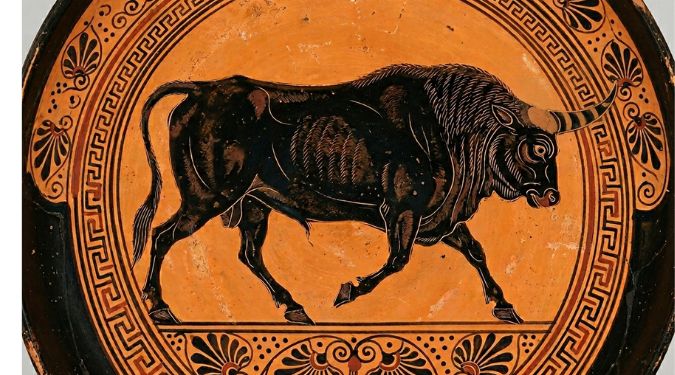
The Jewish Encyclopedia speculates the the “one-horn” aspect may be referring to the oryx or wild oxen, which, when depicted in a profile perspective in ancient times, seemed as if they had only one horn.
Commenting on the word “rhinocerotis” in Numbers 23:22, Fr. George Leo Haydock, a famous 19th century Catholic scholar, opines:
Rhinoceros. Heb. ream, which is sometimes rendered unicorn. Bochart thinks it means the oryx, or the strong Arabian goat. The animal, of which the Scripture so often speaks, was remarkable for its strength, (C.) and could not easily be tamed. Job xxxix. 9. H. — The Sept. generally translate monoceros, which is a fish, with a horn proceeding from its upper jaw. This is often shewn in cabinets for the horn of the unicorn. There are various animals which have only one horn. Pliny and Aristotle instance the oryx, &c. Various authors of credit specify likewise the rhinoceros, which has “a horn upon its nose,” and is found in Ethiopia. The emperor of that country sent one to the court of Persia, which Chardin saw and describes. It is as large as an elephant, and the people have learnt the method of taming both these huge beasts. C. — It seems the art was unknown in the days of Job, if this be the animal of which he speaks. H. — Moses (Deut. xxxiii. 17,) seems to attribute two horns to the ream; and Pausanius allows a greater and a less one to the rhinoceros; the latter is very strong and erect. It is of a brownish colour. C. — Whatever may be the precise meaning of ream, it certainly denotes an animal of superior strength, and very formidable. Balaam represents God, or the people of Israel, in this light. God had given repeated instances of his dominion over all nature, in delivering the Hebrews out of Egypt. They were also capable of striking the Moabites with terror, on account of their own prowess, and surprising numbers, v. 24. H.
It seems that St. Jerome, despite his insistence on the principle of “Hebraica veritas”, was influenced by the Greek Septuagint in his translation of Psalm 22. These translations suggest that the one-horned creature was either a rhinoceros, or a wild ram or ox, and decidedly not the mythical and magical horse-like beast with one horn. Indeed, “wild oxen” seems to be the preference of modern translators.
All very interesting, but…
This is all very interesting to me, but I don’t want to miss the point of the Palm Sunday introit, which when read Christologically, indicates that Our Lord will be surrounded by lethal and overwhelming Powers after he enters Jerusalem. It also foreshadows his use of the opening verse of Psalm 22 while on the cross, “My God, my God, why hast thou forsaken me?“
Works Cited
“7214. reem.” Bible Hub, 2024, biblehub.com/hebrew/7214.htm. Accessed 30 Mar. 2026.
Haydock, George Leo. “Numbers 23.” Haydock Catholic Bible Commentary on the Old Testament, edited by Wildfire Fellowship, e-Catholic 2000, 2023, www.ecatholic2000.com/haydock/untitled-148.shtml.
Hirsch, Emil G., and I. M. Casanowicz. “Unicorn.” Jewish Encyclopedia, edited by Cyrus Adler et al., vol. 12, Funk & Wagnalls, 1906, p. 344. JewishEncyclopedia.com, www.jewishencyclopedia.com/articles/14584-unicorn. Accessed 30 Mar. 2026.
“Psalmi (Psalm) 22 (VUL) – [Vulgate 21:22] salva me ex.” Blue Letter Bible. Web. 29 Mar, 2026. <https://www.blueletterbible.org/vul/psa/22/21/s_500021>.