“All right, but apart from the sanitation, medicine, education, wine, public order, irrigation, roads, the fresh water system and public health, what have the Romans ever done for us?” Monty Python’s Life of Brian
When travelling from Kevala, known in St. Paul’s day as “Neopolis”, to Thessalonki during a recent pilgrimage to Greece, our guide spoke briefly of the ancient roads of the Roman Empire and how these roads played an important role in the spread of the Gospel. She gave us this map:
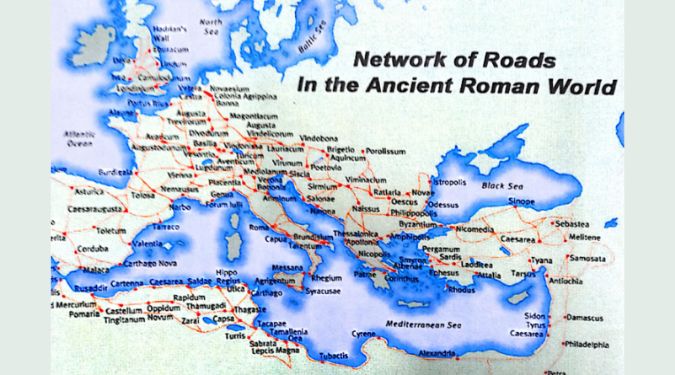
This piqued my interest, so when I returned home, I dug deeper into the topic.
What was the scope of this system of roads?
At its height, the public Roman road system covered an estimated 74,600 miles (120,000 kilometers) (Greene), with some sources indicating a total network of over 400,000 kilometers (248,548.47 miles), including more than 120,000 km (74,564.54 miles) of public roads (Mingren). By the time of Emperor Diocletian (c. A.D. 300), the Romans had built over 53,000 miles of roads throughout the Empire (Yamauchi).
A fascinating Interactive map of the ancient Roman roads may be found here: https://itiner-e.org/
When were the roads constructed?
The construction of the Roman road system began in the 4th century BC and continued through the 4th century AD. It evolved from early military routes within Italy to an extensive network across the entire Roman Empire.
The first major paved route in what became the Roman road network was the Via Appia. Its construction began in 312 BC, initiated by the Roman censor Appius Claudius Caecus. Initially, it served as a military road connecting Rome to the city of Capua in south-central Italy. This initial phase covered 132 Roman miles (approximately 122 modern miles or 196 kilometers) (Greene; Wilson).
Over the next century, the Via Appia was extended in stages, eventually reaching Brundisium (modern Brindisi) on Italy’s eastern coast by 191 BC. This extension brought its total length to 365 Roman miles (about 336 miles or 541 kilometers) (Greene; Wilson).
The construction of roads leading from Rome toward the eastern Mediterranean began in the third century BCE. (Greene; Wilson).
The practice of placing milestones, called milliaria, was was formalized by Caius Gracchus who passed the lex viaria (“road law”) in 123 BC, the oldest known milliarium was placed at Mile 53 of the Via Appia sometime between 255–253 BC. (Wilson).
After the Roman Senate received Asia into the Roman Empire in 129 BCE, Governor Manius Aquillius immediately began expanding the road system in the province (Wilson).
Emperor Augustus reorganized the cursus publicus (postal service) and was particularly focused on road construction. Around 20 BCE, he placed a Golden Milestone (Milliarium Aureum) in the Forum to signify Rome as the hub of the empire’s road system (Wilson). Augustus also improved a road segment from Perga to Lake Ascania as part of his new Via Sebaste in 6 BC (Wilson).
The earliest documented Roman roads in Judea date from the time of the Jewish revolt in A.D. 66, with the first Roman milestone appearing in A.D. 69. (Wilson).
By the time of Emperor Diocletian (A.D. 300), the Romans had built a vast network of over 53,000 miles (approximately 85,000 kilometers) of roads throughout the Empire, primarily for military purposes (Yamauchi).
How were the roads constructed?
The construction of Roman roads was a great feat of engineering, characterized by their straight alignments, solid foundations, and advanced techniques designed for durability and efficiency.
Roman roads were renowned for their straightness, which was to facilitate swift and efficient travel over land. Surveyors, known as gromatici, used tools called groma to chart these straight lines, which were then marked off with stakes and sighting poles. This meticulous planning allowed roads to maintain a relatively straight course, even across challenging terrain, by incorporating architectural features like bridges, tunnels, and viaducts to overcome geographic obstacles (Roman Road System; Wilson).
The roads were built using a multi-layered approach, ensuring their strength and longevity. Typically, three main layers constituted the road surface (Roman Road System; Mingren).
The bottommost layer or foundation, was formulated from a combination of mortar, sand, and soil, which was applied to the road surface, then leveled and flattened. Other materials used for the foundation included stones, earth, rough gravel, crushed bricks, clay material, and even piles of wood when roads were built over swampy areas. (Roman Road System, Mingren).
Above the bottommost layer, a foundation layer consisting of ground rock or lime mortar was added (Roman Road System). This layer could also be composed of softer materials such as sand or fine gravel, sometimes formed by several successive layers (Mingren).
The final surface layer was made from blocks of stone, iron, or volcanic rock, which were manufactured in a uniform shape and laid in regular, consistent patterns. For more prominent areas, especially near cities, the surface was made impressive using blocks of stone (such as volcanic tuff, limestone, or basalt) or cobbles. In other areas, gravel, occasionally mixed with lime, was used for the surface (Roman Road System; Mingren).
To prevent flooding and ensure the roads’ longevity, advanced drainage systems were integrated into the construction. The center of the road sloped to the sides, allowing water to drain off the surface into drainage ditches. Major roads were flanked by drainage ditches and retaining walls on both sides (Roman Road System; Mingren; Greene).
In areas prone to high levels of precipitation or marshy terrain, roads were built on raised apparatuses known as aggers to safeguard against possible flooding (Yamauchi; Roman Road System; Wilson).
Major roads typically had a standard width of 13.8 feet (4.2 meters), which allowed horse-drawn carriages traveling in opposite directions to pass each other without stopping (Roman Road System). Some sources indicate a standard width of fourteen Roman feet (13.5 ft; 4.1 m), though this could vary from 3.6 feet (1.1 m) to 23 feet (7 m) depending on terrain and location (Wilson).
Roman engineers made regular use of bridges, tunnels and viaducts to maintain the straight course of the roads in the face of geographic obstacles like depressions, rivers, and ravines (Roman Road System; Wilson). Some roads even featured sidewalks to accommodate pedestrian traffic (Wilson).
Roman soldiers performed most of the labor required to construct the road surfaces (Roman Road System; Wilson 2–3). After construction, local authorities were responsible for maintaining the roads in their territory (Wilson).
The Mansiones
The mansiones were an integral part of the Roman road system, serving as official state-run service stations along the extensive network of roads. They were essentially the Roman equivalent of modern-day motorway service stations or inns, designed to support long-distance travel and commerce throughout the empire (Roman Road System; Sheldon).
Mansiones were primarily established to facilitate travel for those on official government business, allowing them to change horses and rest. Beyond official use, they also offered food and accommodation to general travelers, making the Roman road system easy to navigate and use for everyone (Roman Road System; Sheldon).
These establishments offered a comprehensive range of services and provisions, including lodging, food, bathing facilities, and other amenities. They often had carpenters, blacksmiths, and veterinarians available to cater to the needs of travelers and their animals (Roman Road System; Wilson).
Mansiones were strategically placed at regular intervals along the Roman road network, typically appearing about every 20 Roman miles (approximately 18.4 miles or 29.6 kilometers) (Roman Road System). This spacing allowed travelers to complete a day’s journey before reaching the next mansio (Wilson). They were part of a broader system of traveler services that also included mutationes (horse-changing stations) located every 10 Roman miles, and other way stations (Roman Road System; Wilson).
One example of a mansio mentioned in historical accounts is the Forum of Appius, located at Roman Mile 43 on the Appian Way and mentioned in Acts 28:15. This mansio was named after the censor who founded the road and was noted by Horace as being “full of boatmen and crooked innkeepers” (Wilson). Another way station, Three Taverns (Tres Tabernae), at Roman Mile 35 and also mentioned in Acts 28:15, provided food and refreshment (Wilson).
Do the Scriptures speak of these roads?
Silas, also known as Silvanus, accompanied Paul on his second missionary journey and later served as a messenger for Peter. His extensive travels across the Roman Empire would have involved traversing several key Roman roads.
Silas joined Paul for his second missionary journey, which began by traveling through Syria and Cilicia (Acts 15:41-16:1). This route involved moving north from Antioch, likely utilizing Roman roads that connected Antioch to cities in Cilicia, such as Tarsus. These roads were part of the broader network connecting the eastern Roman provinces, many of which were enhanced by the Romans (Wilson).
Paul and Silas continued their journey into Asia Minor, revisiting churches in cities like Derbe, Lystra, Iconium, and Antioch of Pisidia (Acts 16:1-6).
During Paul’s first missionary journey, he used the Via Sebaste, a road built under Augustus in 6 BC, which connected six military colonies, including Antioch in Pisidia (Yamauchi). While Silas was not on the first journey, it is highly probable that he and Paul utilized segments of the Via Sebaste or other connecting Roman roads when revisiting these areas on the second journey too.
After traveling through Asia Minor, Paul and Silas sailed to Macedonia. Upon landing at Neapolis (the port of Philippi), Paul and Silas took the Via Egnatia from Philippi to Thessalonica (Yamauchi; Wilson). This was a major Roman highway built after the Romans took over Macedonia in 148 BC. It spanned Greece and was eventually extended east beyond Philippi to Byzantium (Yamauchi).
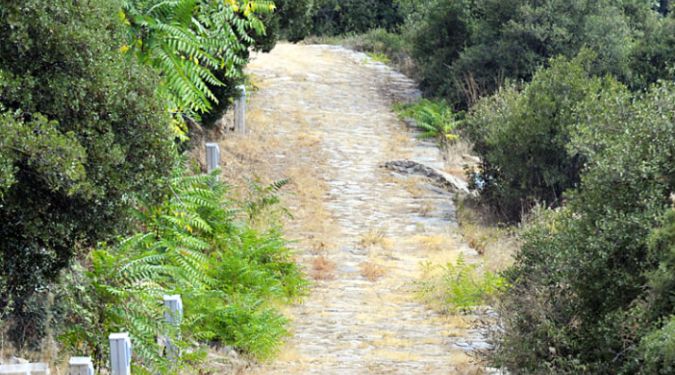
Paul and Silas left the Via Egnatia when they went south to Berea (Yamauchi; Wilson). This journey from Thessalonica to Berea involved traveling down a coastal road that turned inland (Wilson).
A significant journey attributed to Silas, distinct from his travels with Paul, is his role as a messenger for Peter. Silas, as the messenger for 1 Peter, traveled the Via Appia to Brundisium (Wilson).
After ferrying from Brundisium to Dyrrachium, Silas then traversed the Via Egnatia through Thrace to Byzantium (Wilson). This demonstrates his use of the Via Egnatia again, but in a westward direction from the Adriatic coast.
Aquila and Priscilla, a Jewish Christian couple, were also significant figures in the early church, known for their close association with the Paul. Their travels, as recorded in the New Testament, involved both sea and land routes, with the land portions almost certainly utilizing the Roman road system. Aquila and Priscilla are first introduced in Acts 18:2, where Paul meets them in Corinth. They had “recently come from Italy with his wife Priscilla, because Claudius had ordered all Jews to leave Rome.” This expulsion decree by Emperor Claudius (around 49 AD) necessitated their journey from Rome to Greece.
To travel from Rome to Greece, they would have needed to reach a major port city in Italy. The most common and direct route from Rome to the East was via the port of Brundisium (modern Brindisi) on the Adriatic coast (Wilson, 2020, p. 5). To reach Brundisium from Rome, they would have almost certainly traveled along the Via Appia.
Paul’s letter to the Romans (Romans 16:3-5), written around 57 AD, includes a greeting to Aquila and Priscilla, indicating they had returned to Rome. This implies that after Claudius’s edict against Jews in Rome was lifted or relaxed, they returned to their former home, likely in a manner reverse of the one described above.
Paul’s Journey to Rome
Paul, on his journey to Rome for trial, landed at Rome’s port of Puteoli and then traveled on the Via Appia to Rome, being met by believers at the Forum of Appius and Three Taverns, both mansiones on the Via Appia (Wilson).
Where did Paul stay when he travelled?
When traveling, Paul primarily relied on the hospitality of fellow believers rather than staying in commercial inns.
Christians were encouraged to practice hospitality for traveling believers, opening their homes to preachers and other travelers. The elder John commended his friend Gaius for doing this, stating, “You are faithful in what you are doing for the brothers even though they are strangers to you…. You will do well to send them on their way in a manner worthy of God” (3 John 5:8).
Paul himself enjoyed the hospitality of several individuals during his journeys, including: Lydia in Philippi (Acts 16:15), Jason in Thessalonica (Acts 17:5), Gaius in Corinth (Romans 16:23). An early Christian document, the Didache, even provided guidelines for this hospitality, suggesting that an apostle should not stay for more than one or two days to prevent abuse (Yamauchi).
Well-to-do Romans generally avoided inns if possible, often preferring to set up their own tents or stay with friends. Roman writers frequently criticized inns for their poor quality, including “adulterated wine, filthy sleeping quarters, extortionate innkeepers, gamblers, thieves, and prostitutes” (Yamauchi).
The New Testament never explicitly states that Paul stayed in an inn, even when Christians from Rome met Paul at the Forum of Appius and the Three Taverns (Acts 28:15) (Yamauchi). As a tentmaker, Paul might have used a goat-hair sheet for basic shelter from inclement weather (Wilson).
Conclusion
St. Paul, his helpers, and the other early Christian evangelizers made full use of the Roman road system of their day to spread the Gospel, demonstrating that what was intended by worldly powers to maintain their dominance can, by God’s providence, be used to spiritually upend those powers.
————————————-
Sources
Greene, Jim. “Roman road system | Research Starters.” EBSCO, https://www.ebsco.com/research-starters/history/roman-road-system. Accessed 29 October 2025.
Mingren, Wu. “The Many Roads to Rome.”, Classical Wisdom, https://classicalwisdom.substack.com/p/the-many-roads-to-rome. Accessed 2 November 2025.
Sheldon, Natasha. “Ancient Roman Inns and Hotels.” History and Archaeology Online, 6 February 2021, https://historyandarchaeologyonline.com/ancient-roman-inns-and-hotels-history-and-archaeology-online/. Accessed 2 November 2025.
“Roman road system”. Encyclopedia Britannica, 15 Dec. 2024, https://www.britannica.com/technology/Roman-road-system. Accessed 29 October 2025.
Wilson, Mark. “The Roman Road System around the Mediterranean.” Lexham Geographic Commentary on Acts Through Revelation, pp. 175–194.
Yamauchi, Edwin M. “On the Road With Paul | Christian History Magazine.” Christian History Institute, https://christianhistoryinstitute.org/magazine/article/on-the-road-with-paul. Accessed 29 October 2025.