
When discussing church history at recent breakfast meeting of our Catholic Book Club, one participant wondered whether St. Paul was ever ordained by one or more of the original Apostles, or whether he needed to be.
Appointed by Our Lord Himself
The answer from inspired Sacred Scripture, is straightforward. We read in St. Paul’s letter to the Galatians:
Paul an apostle—not from men nor through man, but through Jesus Christ and God the Father, who raised him from the dead…” Galatians 1:1 RSVCE
And
For I would have you know, brethren, that the gospel which was preached by me is not man’s gospel. For I did not receive it from man, nor was I taught it, but it came through a revelation of Jesus Christ. Galatians 1:11-12 RSVCE
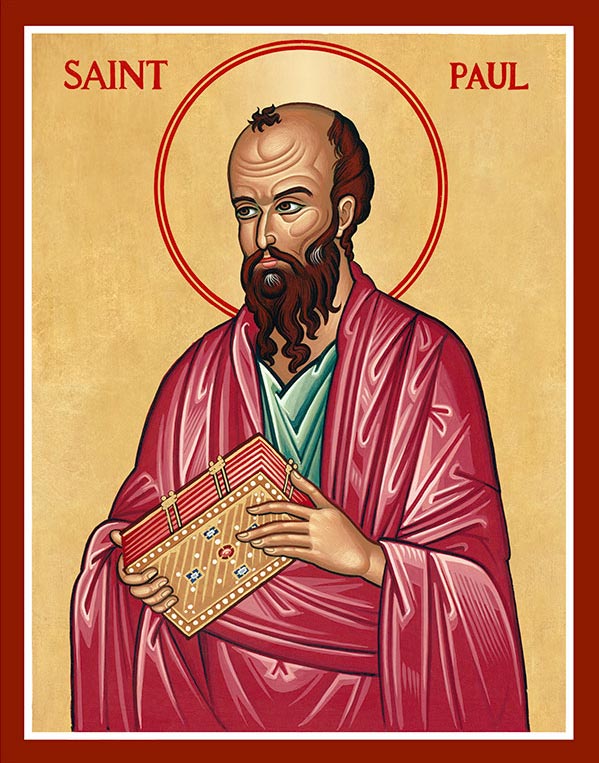
St. Paul was appointed as an apostle by Our Lord himself.
The Church confirms this:
“Paul…was called to the apostolate by the risen Lord himself and thus became part of the Church’s foundation, is aware of the need to be in communion with the Twelve.” (International Theological Commission)
More Scriptural Assertions
St. Paul also claimed to be an true apostle in his second letter to the Corinthians (2 Corinthians 11:23-33; 12:11-12) and in his first letter to Timothy (1 Timothy 2:7).
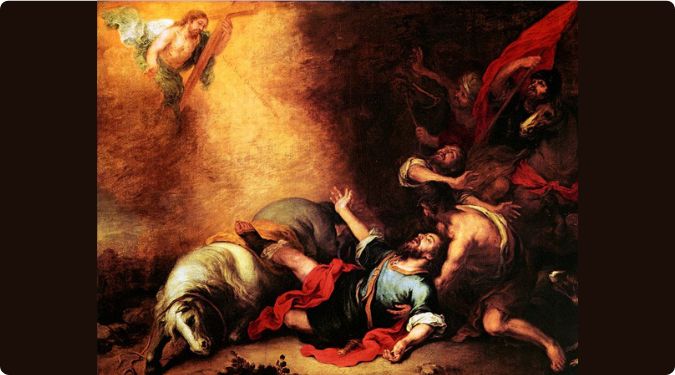
Like the other apostles, St. Paul encountered our resurrected Lord face to face, as he attests in 1 Corinthians 9:1; 15:8-10.
In the Acts of the Apostles, we read that the Holy Spirit instructed the church in Antioch to set Saints Paul and Barnabas aside to be sent to preach the Gospel to the Gentiles:
Now in the church at Antioch there were prophets and teachers, Barnabas, Symeon who was called Niger, Lucius of Cyre′ne, Man′a-en a member of the court of Herod the tetrarch, and Saul. While they were worshiping the Lord and fasting, the Holy Spirit said, “Set apart for me Barnabas and Saul for the work to which I have called them.” Then after fasting and praying they laid their hands on them and sent them off. So, being sent out by the Holy Spirit, they went down to Seleu′cia; and from there they sailed to Cyprus. Acts 13:1-4 RSVCE
St. John Chrysostom (347-407 AD), commenting on this passage, taught:
“What means, Ministering? Preaching. Separate for Me, it says, Barnabas and Saul. What means, Separate for Me? For the work, for the Apostleship. See again by what persons he is ordained (γυμνοτέρα. Cat. σεμνοτέρα, more awful.) By Lucius the Cyrenean and Manaën, or rather, by the Spirit. The less the persons, the more palpable the grace. He is ordained henceforth to Apostleship, so as to preach with authority. How then does he himself say, Not from men, nor by man? Galatians 1:1 Because it was not man that called or brought him over: this is why he says, Not from men. Neither by man, that is, that he was not sent by this (man), but by the Spirit. Wherefore also (the writer) thus proceeds: So they, being sent forth by the Holy Ghost, departed unto Seleucia; and from thence they sailed to Cyprus. Acts 13:4 “
St. Jerome (393 AD), while not disputing that St. Paul received his apostleship from Our Lord, speculated that St. Paul was ordained in Jerusalem when visiting there to consult with Saints Peter, James and John:
As Sergius Paulus Proconsul of Cyprus was the first to believe in his preaching, he took his name from him because he had subdued him to faith in Christ, and having been joined by Barnabas, after traversing many cities, he returned to Jerusalem and was ordained apostle to the Gentiles by Peter, James and John.
That St. Paul was actually ordained in Jerusalem cannot be ascertained from Sacred Scripture and no corroborating speculation of a similar kind can be found in any of the writings of other Church Fathers.
Works Cited
Chrysostom, John. Homily 27 on the Acts of the Apostles. Translated by J. Walker, J. Sheppard, and H. Browne, revised by George B. Stevens. New Advent, edited by Kevin Knight, 2026, www.newadvent.org/fathers/210127.htm.
International Theological Commission. “Catholic Teaching on Apostolic Succession.” The Holy See, 1973, www.vatican.va/roman_curia/congregations/cfaith/cti_documents/rc_cti_1973_successione-apostolica_en.html.
Jerome. De Viris Illustribus (On Illustrious Men). Translated by Ernest Cushing Richardson. New Advent, edited by Kevin Knight, 2026, www.newadvent.org/fathers/2708.htm.