
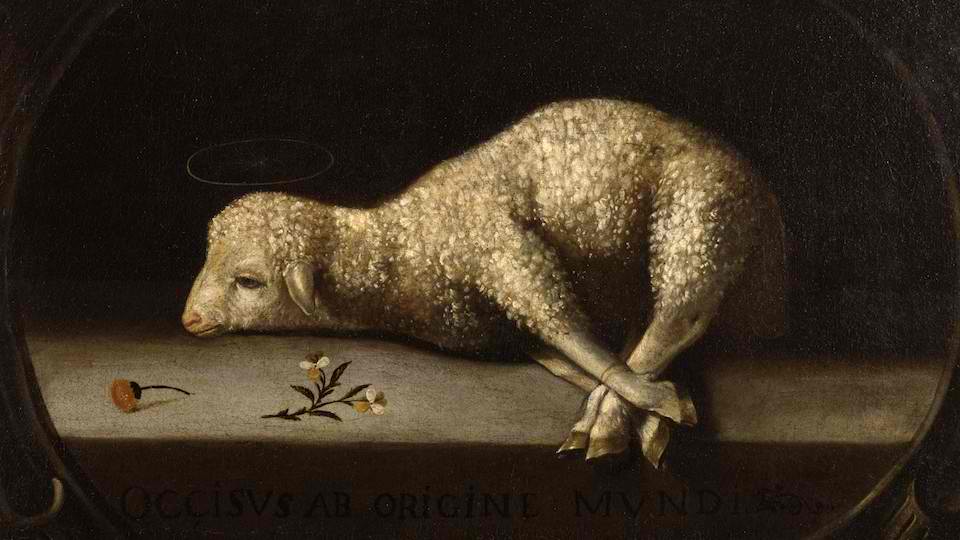

For our sake he made him to be sin who knew no sin, so that in him we might become the righteousness of God. 2 Corinthians 5:21
How could God have made Our Lord “to be sin?” In what sense is this true?
When commenting on this passage, St. Augustine of Hippo, an early Doctor of the Church, asserted that “under the Old Covenant, sacrifices for sin were called sins”:
therefore having no sin of His own; nevertheless, on account of the likeness of sinful flesh in which He came, He was called sin, that He might be sacrificed to wash away sin. For, under the Old Covenant, sacrifices for sin were called sins. And He, of whom all these sacrifices were types and shadows, was Himself truly made sin. The Enchiridion on Faith, Hope and Love, Chapter 41
Scripture scholars Scott Hahn and Curtis Mitch agree:
“Paul adopts the idiom of the Greek OT, where “sin” is a shorthand expression for a Levitical “sin offering” (Lev 4:21; 5:12; 6:25). Isaiah uses this same language for the suffering Messiah, who was expected to make himself an “offering for sin” (Is 53:10).” (Hahn and Mitch 2056)
As does Catholic apologist Trent Horn:
Another interpretation of 2 Corinthians 5:21 is that “made him to be sin” means “made him to be a sin offering.” The Greek word for sin in this passage can also mean “sin offering,” or what is sacrificed to take away sin. Another place where we find it is Hebrews 10:6, which quotes Psalm 40, which refers to sacrifices. It literally says in Greek: “Burnt offering and for sin you have not delighted in,” so most translators render “sin” in this passage “sin offering” because that makes the most sense of the context.
It’s reasonable to conclude that the same is true of 2 Corinthians 5:21 because Paul makes it clear Christ himself is a paschal sacrifice. He says in 1 Corinthians 5:7, “Cleanse out the old leaven that you may be a new lump, as you really are unleavened. For Christ, our paschal lamb, has been sacrificed.” (Horn)
As Hahn and Mitch mention, we see this in both the Hebrew Old Testament and Greek (Septuagint) Old Testament, particularly in the Book of Leviticus. For example:
And he shall carry forth the bull outside the camp, and burn it as he burned the first bull; it is the sin offering for the assembly. Leviticus 4:21 RSVCE
The word used in the Hebrew text of this passage for “sin offering” is חַטָּאָה (khat-taw-AW) which can mean both “sin” and “sin offering”. (Strong’s Hebrew: 2403)
In the Septuagint, the Greek translation of the Hebrew Scriptures favored by the inspired authors of the New Testament, the Koine Greek word ἁμαρτία (hah-mar-TEE-ah) is used to translate the Hebrew חַטָּאָה in Leviticus 4:21.
Ἁμαρτία, like חַטָּאָה can mean both “sin” and “sin offering,” (Strong’s Greek: 266) and ἁμαρτία is precisely the word St. Paul uses in 2 Corinthians 5:21. Thus, “made him to be sin” can be considered to be equivalent to “made him to be a sin offering.”
Works Cited
Augustine. The Enchiridion on Faith, Hope and Love. Translated by J. F. Shaw, edited by Philip Schaff, Christian Literature Publishing Co., 1887. New Advent, revised and edited by Kevin Knight, www.newadvent.org/fathers/1302.htm.
“Greek Septuagint.” Kata Biblon, https://en.katabiblon.com/us/?text=LXX. Accessed 1 February 2025.
Hahn, Ph.D., Scott, and Curtis J. Mitch, M.A., editors. The Ignatius Catholic Study Bible. San Francisco, Ignatius Press, 2024.
Horn, Trent. “Protestant Sin-Swapping.” Catholic Answers, 18 Sept. 2024, www.catholic.com/magazine/online-edition/2-corinthians-and-the-great-sin-swap.
“Strong’s Greek: 266. ἁμαρτία (hamartia) — Sin.” Bible Hub, 2026, biblehub.com/greek/266.htm.
“Strong’s Hebrew: 2403. חַטָּאָה (chatta’ah) — Sin, sin offering.” Bible Hub, 2026, biblehub.com/hebrew/2403.htm.



the only one who knows my sins is God.i have decided to interact him always.I reserve others words to him only.