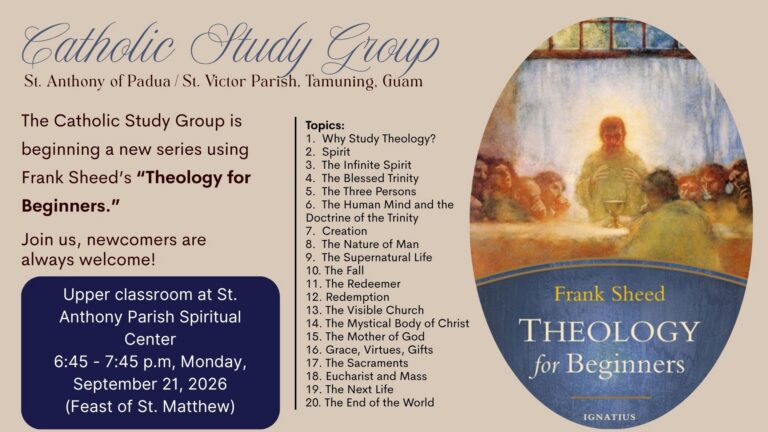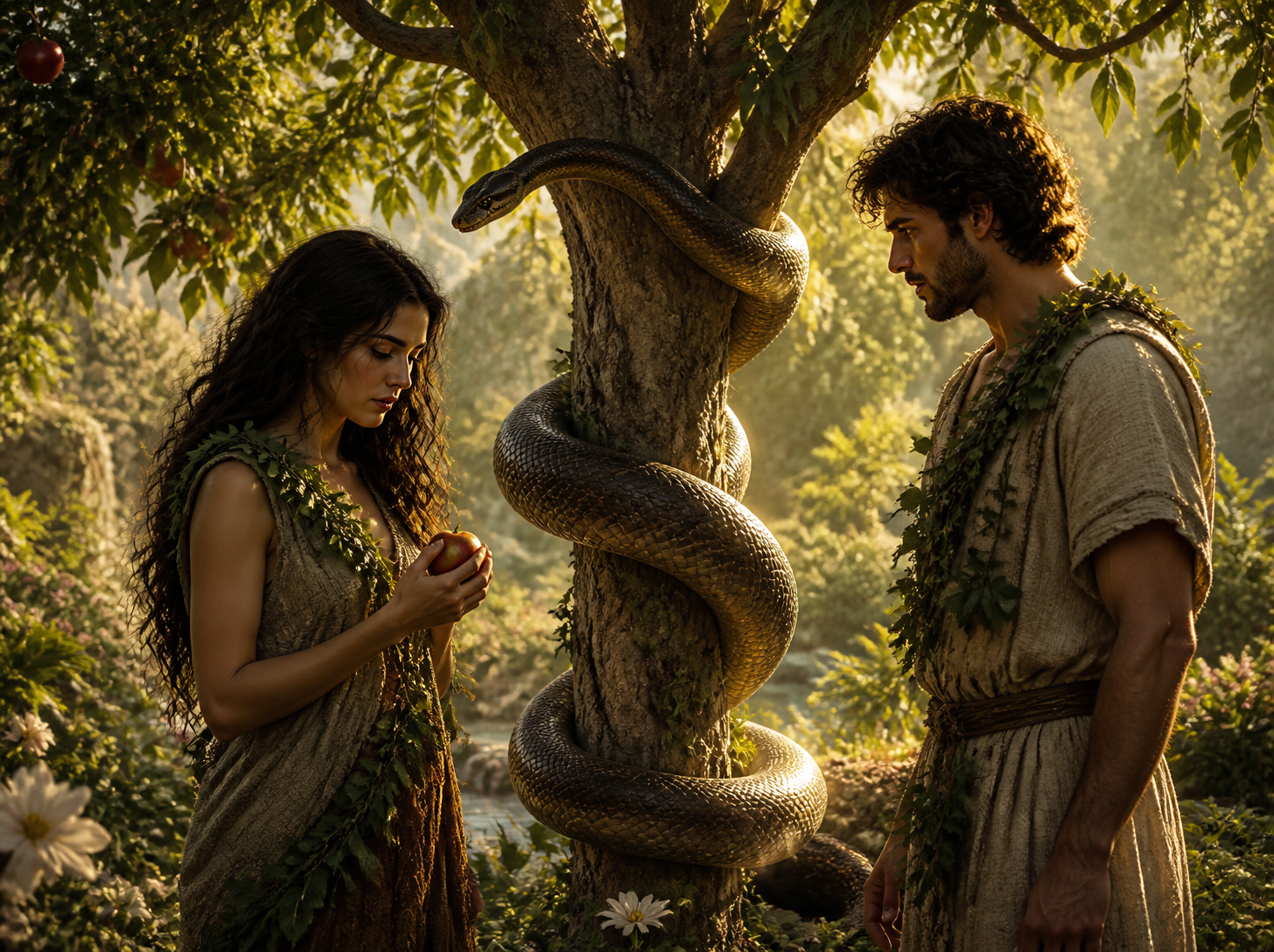

The subject of the state of man prior to the Fall came up recently in our Catholic Study Group and I realized that the gifts enjoyed by our first parents prior to the Fall were not very well known, so I gathered some good sources and listed them here. While our bodies and souls themselves are gifts, the gifts that I am discussing here can be categorized as either Supernatural or Preternatural.
The Supernatural Gifts
Sanctifying Grace (Gratia Sanctificans) accompanied by the Theological Virtues and the Gifts of the Holy Spirit
Our first parents were created “in justice and holiness, i.e., in friendship with God, possessing sanctifying grace and all virtues and gifts of the Holy Spirit…However, their friendship with God needed to be perfected by perseverance.” (Schneider q 164)
This gift of Sanctifying grace to our original parents included the right to the Beatific Vision (Summa Theologica I, q. 102, a. 2 and I, q. 97, a. 1). St. Robert Bellarmine tells us that “[God] willed after some time to transfer them to the Heaven, to the glorious and eternal life that the angels enjoyed.” (Bellarmine, chp XVII) This would presumably be a translation of some sort to heaven without involving death.
The Preternatural Gifts (Dona Praeternaturalia)
God gave our first parents other gifts too, the “preternatural gifts” or “the Gifts of Integrity.” “Preternatural” means “out of the ordinary course of nature; exceptional or abnormal” and is an adjective based on the Latin phrase praeter nātūram “beyond nature” (“Preternatural”). Bishop Schneider says that they were “extraordinary privileges beyond the perfection required by human nature, which served to preserve the integrity of man’s nature in the highest excellence.” (Schneider q 167)
Bishop Schneider also says that two of these gifts were applied to the soul of man and two were applied to his body. (Schneider q. 168)
Preternatural gifts in man’s soul
The Gift of Infused Knowledge (Donum Scientiae or Scientia Infusa)
Ott tells us that the Gift of Infused Knowledge was:
“a knowledge of natural and supernatural truths infused by God. Since our first parents, according to Holy Writ, entered into existence in an adult state and were the first teachers and educators of humanity, it was appropriate that they should be equipped by God with a natural knowledge suitable to their age and their tasks, and with that measure of supernatural knowledge which was necessary to enable them to achieve their supernatural destiny. “ (Ott 104)
Frank Sheed explains,
“He did not have to find out everything for himself, by experience and meditation upon experience and the comparison of his own experience with other people’s. He began with an initial equipment of knowledge, simply given to him by God. Contained in this knowledge was all that he needed in order to live intelligently according to the plan God had for him. There is no suggestion in all this that Adam could not grow in knowledge, but only that, starting out in this universe with no men before him, he had from God all the knowledge that he needed.” (Sheed 183-184)
The Gift of Righteousness (Donum Rectitudinis)
The Gift of Righteousness is the freedom from irregular desire. Bishop Schneider tells us that Adam had “perfect order in his passions, which were wholly subjected to his reason.” (Schneider q 168)
Sheed explains, “The body was ruled by the soul and accepted the soul’s rule without rebellion. Within the soul reason ruled, and the first law of reason which is acceptance of the will of God.” (Sheed 183)
The Catechism of the Catholic Church teaches:
“The first man was unimpaired and ordered in his whole being because he was free from the triple concupiscence that subjugates him to the pleasures of the senses, covetousness for earthly goods, and self-assertion, contrary to the dictates of reason.” (CCC 377)
Preternatural gifts in man’s body
The Gift of Bodily Immortality (Donum Immortalitatis)
The Gift of Bodily Immortality is to be conceived as “posse non mori” ( the possibility of not dying) and not as “non posse mori” (the impossibility of dying). (Ott 104)
The Gift of Freedom from Suffering (Donum Impassibilitatis)
The Gift of Freedom from Suffering, is, according to Ott, “to be more closely defined as “posse non pati” (the possibility of remaining free from suffering). (Ott 104)
The gifts were hereditary
The Gift of Sanctifying Grace, the Gift of Righteousness, the Gift of Bodily Immortality, and the Gift of Freedom from Suffering were intended by God to be passed on to future generations. According to Ott,
Adam received sanctifying grace not merely for himself, but for all his posterity. The Council of Trent teaches that Adam lost sanctity and justice (= sanctifying grace) not merely for himself: but also for us (D 789). It follows from this, that he received these not only for himself but also for us his descendants. The preternatural gifts of integrity (with the exception of the donum scientiae) were hereditary, for these were bestowed for the sake of sanctifying grace. (Ott 105)
Conclusion
In short, these were the gifts that we lost in the Fall. Thanks to our Redeemer, we will one day regain them all in their fulfillment in our resurrected bodies, but until then we know that we fallen men may receive Sanctifying Grace and the Gifts of the Holy Spirit in the sacraments of Baptism and Confirmation and have them restored thereafter in the Sacrament of Penance.
Works Cited
Aquinas, Thomas. “Question 97. The Preservation of the Individual in the Primitive State.” The Summa Theologiæ of St. Thomas Aquinas, translated by Fathers of the English Dominican Province, 2nd and rev. ed., 1920. Edited by Kevin Knight, online ed., New Advent, www.newadvent.org/summa/1097.htm#article1. Accessed 11 Nov. 2026.
Aquinas, Thomas. “Question 102. The Terrestrial Paradise.” The Summa Theologiæ of St. Thomas Aquinas, translated by Fathers of the English Dominican Province, 2nd and rev. ed., 1920. Edited by Kevin Knight, online ed., New Advent, www.newadvent.org/summa/1102.htm#article2. Accessed 11 Nov. 2026.
Bellarmine S. J., Robert. Doctrina Christiana: The Timeless Catechism of St. Robert Bellarmine, Doctor of the Church, Patron of Catechists. Translated by Ryan Grant, Mediatrix Press, 2016.
Catechism of the Catholic Church: Complete and Updated. Crown Publishing Group, 1995.
Council of Trent. “General Council of Trent: Fifth Session.” Papal Encyclicals Online, 17 June 1546, www.papalencyclicals.net/councils/trent/fifth-session.htm.
Ott, L. (1974). Fundamentals of Catholic Dogma (J. Bastible, D.D., Ed.; P. Lynch, Trans.). Tan Books and Publishers.
“Preternatural.” Dictionary.com, 2026, www.dictionary.com/browse/preternatural. Accessed 9 Nov. 2026.
Schneider, Athanasius. Credo: Compendium of the Catholic Faith. Sophia Institute Press, 2023.
Sheed, Frank. Theology and Sanity. 1946. Ignatius Press, 1993.