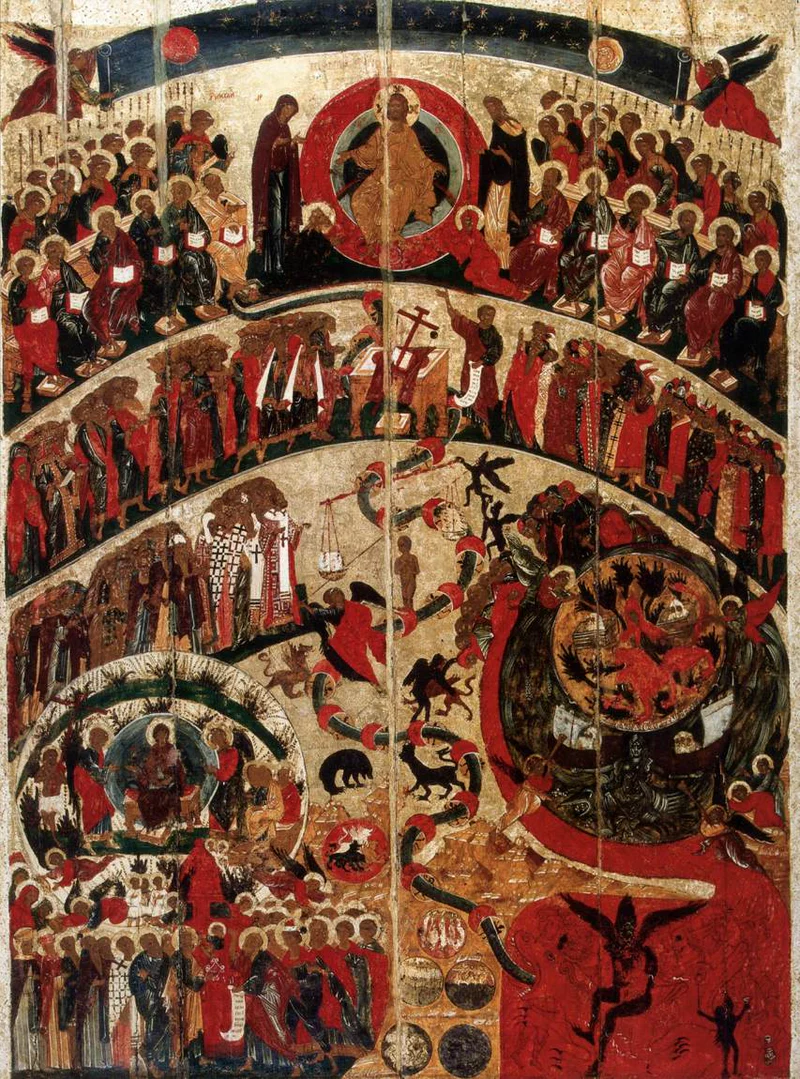

St. Paul seems to contradict himself when he says in first letter to the Corinthians:
Do you not know that the saints will judge the world? And if the world is to be judged by you, are you incompetent to try trivial cases?” 1 Corinthians 6:2
and in his second letter to them:
“For we must all appear before the judgment seat of Christ, so that each one may receive good or evil, according to what he has done in the body.” 2 Corinthians 5:10
Will faithful Christians be the judges at the Final Judgment or will they be among those judged? How can they be both?
St. Thomas Aquinas provides three possible ways to resolve this seeming contradiction, in part by using Our Lord’s reference to “the men of Nineveh” in Matthew 12:41. He tells us:
“…They do this in three ways: first, comparatively, i.e., not only in the sense that good men will judge evil men, and saints the worldly, but also that the good will be judged by the better and the evil by the worse, according to Matt (12:41): “The men of Nineveh will arise at the judgment with this generation and condemn it.” Secondly, they will judge by approving the sentence of the judge, i.e., Christ; and this will be reserved to the just: “The just man will rejoice when he sees the vengeance” (Ps 58:10); “The saints shall judge nations” (Wis 3:8). In a third way by passing sentence, and this will be done by the apostles and those like them who held worldly things in contempt and clung only to spiritual things, as it says above (2:15). Hence Matt (19:28) says: “You who have followed me will sit on twelve thrones judging the twelve tribes of Israel,” and in Ps 149 (v. 4): “Two edged swords in their hands to wreak vengeance on the nations.” This passing of sentence will not be vocal but spiritual, inasmuch as lesser saints or even sinners will be enlightened with a spiritual light by the higher saints to understand what sort of punishments or rewards are owed to them; just as even now men are enlightened by angels, or even lesser angels by higher ones.”
In his Catena Aurea, St. Thomas comments on Matthew 12:41:
“The men of Nin′eveh will arise at the judgment with this generation and condemn it; for they repented at the preaching of Jonah, and behold, something greater than Jonah is here.” Matthew 12:41
He quoted St. Jerome as saying that the men of Nineveh will judge that wicked generation “not by a sentence of judgment, but by the comparison of their example.”
Works Cited
Aquinas, Thomas. Catena Aurea: Commentary on the Four Gospels, Collected Out of the Works of the Fathers: St. Matthew. Christian Classics Ethereal Library, https://www.ccel.org/ccel/aquinas/catena1.ii.xii.html. Accessed 6 Aug. 2026.
Aquinas, Thomas. Commentary on the First Epistle to the Corinthians. Translated by Fabian Larcher, edited by Joseph Kenny, Isidore.co, https://isidore.co/aquinas/english/SS1Cor.htm. Accessed 6 Aug. 2026.