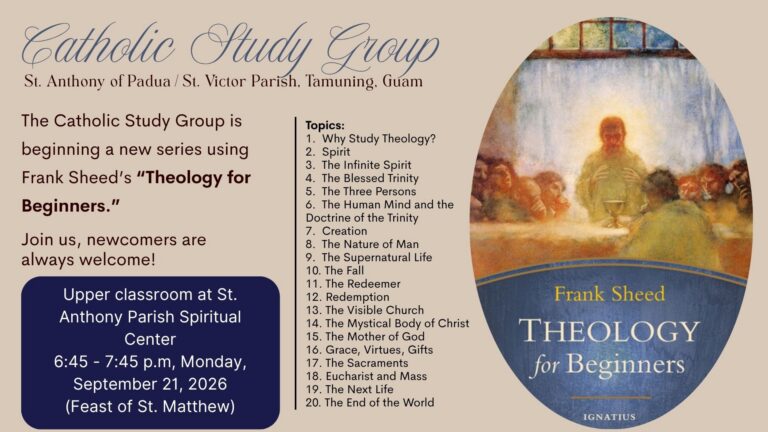
I recently encountered this seemingly controversial verse in our weekly Catholic Study Group:
“Now I rejoice in my sufferings for your sake, and in my flesh I complete what is lacking in Christ’s afflictions for the sake of his body, that is, the church…” Colossians 1:24
What could be “lacking” in Christ’s afflictions? Wasn’t His sacrificial death for us sufficient?
St. Augustine
When posed with a provocative verse like this, I have often found it best to consult the Doctors of the Church and saints.
Let us begin with St. Augustine:
And that’s why the same apostle, while he was still Saul, heard the words, Saul, Saul, why are you persecuting me? (Acts 9:4); because the body is joined to the head. And when as a preacher of Christ he was now suffering from others what he had done himself as a persecutor, that I may fill up, he said, in my flesh what is lacking from the afflictions of Christ (Col 1:24); thus showing that what he was suffering was part and parcel of the afflictions of Christ. This can’t be understood of the head, which now in heaven is not suffering any such thing; but of the body, that is the Church; the body, which with its head is the one Christ. Sermon 341,12 (St. Augustine 27)
St. Augustine reminds us of St. Paul’s conversion and tells us that the sufferings that are “lacking” are the sufferings of Christ’s body, the Church. Persecuting the Church is persecuting Jesus himself. That we can read about in the ninth chapter of the Book of Acts:
And he fell to the ground and heard a voice saying to him, “Saul, Saul, why do you persecute me?” And he said, “Who are you, Lord?” And he said, “I am Jesus, whom you are persecuting; Acts 9:4-5
Our Lord himself revealed to St. Paul the truth of what we now call the “Mystical Body of Christ”, that Christians are all members of Our Lord’s body with Our Lord as the head. This is a major theme of St. Paul’s teaching and he expounds upon it in his first to the Corinthians and to the Ephesians. (1 Corinthians 12:12- 27; Ephesians 5:29-30)
During the first days of his conversion Our Lord also revealed to Paul that he would suffer. Our Lord sent Ananias to Paul:
But the Lord said to him [Ananias], “Go, for he is a chosen instrument of mine to carry my name before the Gentiles and kings and the sons of Israel; for I will show him how much he must suffer for the sake of my name.” Acts 9:15-16
So from the very beginning of his life in Christ St. Paul knew that he was to suffer from bringing Christ to the world and he was well aware that a significant role of Christians was to suffer with Christ or to share in His suffering. To the elders of the church in Ephesus, Paul said:
And now, behold, I am going to Jerusalem, bound in the Spirit, not knowing what shall befall me there; except that the Holy Spirit testifies to me in every city that imprisonment and afflictions await me. Acts 20:22-23
To the Philippians he said:
that I may know him and the power of his resurrection, and may share his sufferings, becoming like him in his death. Philippians 3:10
He also taught that suffering was integral to a life in Christ for all Christians. He said this to the Christians in Rome:
it is the Spirit himself bearing witness with our spirit that we are children of God, and if children, then heirs, heirs of God and fellow heirs with Christ, provided we suffer with him in order that we may also be glorified with him. Romans 8:16-17
He also taught this to the Christians in Philippi during his first imprisonment (house arrest) in Rome 60-62 AD (Hahn and Mitch 2093):
For it has been granted to you that for the sake of Christ you should not only believe in him but also suffer for his sake, engaged in the same conflict which you saw and now hear to be mine. Philippians 1:29-30
And to the new Christians in Galatia:
When they had preached the gospel to that city and had made many disciples, they returned to Lystra and to Ico′nium and to Antioch, strengthening the souls of the disciples, exhorting them to continue in the faith, and saying that through many tribulations we must enter the kingdom of God. Acts 14:21-22
And to his co-worker, St. Timothy:
Now you have observed my teaching, my conduct, my aim in life, my faith, my patience, my love, my steadfastness, my persecutions, my sufferings, what befell me at Antioch, at Ico′nium, and at Lystra, what persecutions I endured; yet from them all the Lord rescued me. Indeed all who desire to live a godly life in Christ Jesus will be persecuted, while evil men and impostors will go on from bad to worse, deceivers and deceived. 2 Timothy 3:10-13
What is “lacking” then, are the sufferings yet to be suffered by the members of the Church, Our Lord’s disciples. This should come as no surprise to believers, since Our Lord said,
And he said to all, “If any man would come after me, let him deny himself and take up his cross daily and follow me. Luke 9:23
St. Paul’s Sufferings
St. Paul details the persecutions and suffering he faced in his second letter to the Christians in Corinth:
Are they servants of Christ? I am a better one—I am talking like a madman—with far greater labors, far more imprisonments, with countless beatings, and often near death. Five times I have received at the hands of the Jews the forty lashes less one. Three times I have been beaten with rods; once I was stoned. Three times I have been shipwrecked; a night and a day I have been adrift at sea; on frequent journeys, in danger from rivers, danger from robbers, danger from my own people, danger from Gentiles, danger in the city, danger in the wilderness, danger at sea, danger from false brethren; in toil and hardship, through many a sleepless night, in hunger and thirst, often without food, in cold and exposure. 2 Corinthians 11:23-27
St. Paul told the Galatians that he bore the marks of Jesus on his body:
But far be it from me to glory except in the cross of our Lord Jesus Christ, by which the world has been crucified to me, and I to the world… Henceforth let no man trouble me; for I bear on my body the marks of Jesus. Galatians 6:14,17
Not all persecution
In the same letter we read that not all of St. Paul’s sufferings were the result of persecution. He also faced some sort of malady, weakness or infirmity:
Therefore, so that I would not become arrogant, a thorn in the flesh was given to me, a messenger of Satan to trouble me—so that I would not become arrogant. I asked the Lord three times about this, that it would depart from me. 2 Corinthians 12:7b-8
you know it was because of a bodily ailment that I preached the gospel to you at first; and though my condition was a trial to you, you did not scorn or despise me, but received me as an angel of God, as Christ Jesus. Galatians 4:13-14
This ailment might have been a visual handicap, because he also told the Galatians:
What has become of the satisfaction you felt? For I bear you witness that, if possible, you would have plucked out your eyes and given them to me. Galatians 4:15
And:
See with what large letters I am writing to you with my own hand. Galatians 6:11
Why suffering?
Suffering and weakness is scorned by the world, but our Lord revealed something startling to St. Paul about those things:
But he said to me, “My grace is enough for you, for my power is made perfect in weakness.” So then, I will boast most gladly about my weaknesses, so that the power of Christ may reside in me. Therefore I am content with weaknesses, with insults, with troubles, with persecutions and difficulties for the sake of Christ, for whenever I am weak, then I am strong. 2 Corinthians 12:9-10
He explains this with more detail in his second letter to the Corinthians:
But we have this treasure in earthen vessels, to show that the transcendent power belongs to God and not to us. We are afflicted in every way, but not crushed; perplexed, but not driven to despair; persecuted, but not forsaken; struck down, but not destroyed; always carrying in the body the death of Jesus, so that the life of Jesus may also be manifested in our bodies. 2 Corinthians 4:7-10
He explained this to the Romans too:
I consider that the sufferings of this present time are not worth comparing with the glory that is to be revealed to us…Likewise the Spirit helps us in our weakness; for we do not know how to pray as we ought, but the Spirit himself intercedes for us with sighs too deep for words…. We know that in everything God works for good with those who love him, who are called according to his purpose. … Who shall separate us from the love of Christ? Shall tribulation, or distress, or persecution, or famine, or nakedness, or peril, or sword? Romans 8:18, 26,28,35
St. Alphonsus Liguori
St. Alphonsus Liguori (1696 – 1787), an Italian priest, bishop of Sant’Agata dei Goti, and founder of the Redemptorist congregation and Doctor of the Church, wrote this concerning the passage in Colossians that we are considering:
…we must not neglect to do our part to satisfy God for the injuries we have done to him, and to attain with our good works to eternal life. This the Apostle expressed when he said, “I fill up that which is wanting of the Passion of Christ in my flesh.” Was the Passion of Christ, then, not complete, not enough alone to save us? It was most complete in its value, and most sufficient to save all men; nevertheless, in order that the merits of the Passion may be applied to us, says St. Teresa, we must do our part, and suffer with patience the crosses which God sends us, that we may be like our head, Jesus Christ…Still we must ever remember, as the Angelic Doctor warns us, that all the virtue of our good works, satisfactions, and penances, is communicated to them by the satisfaction of Jesus Christ: The satisfaction of man has its efficacy from the satisfaction of Christ. And thus we reply to the Protestants, who call our penances injurious to the Passion of Jesus Christ, as if it were not sufficient to satisfy for our sins. (Ligouri 335-336)
We bear our crosses “in order that the merits of the Passion may be applied to us” explained St. Alphonsus. Our sufferings then, can make us more like Our Lord and that ultimately, all of the good of our acts flow from the satisfaction made by Him.
St. Alphonsus mentions another Doctor of the Church, St. Thomas Aquinas (c. 1225 – 1274), an Italian Dominican friar, philosopher and theologian best known for his monumental work Summa Theologiae. St. Thomas addresses the passage in question from Colossians in his Summa:
The reason why they so avail is the oneness of the mystical body in which many have performed works of satisfaction exceeding the requirements of their debts; in which, too, many have patiently borne unjust tribulations whereby a multitude of punishments would have been paid, had they been incurred. So great is the quantity of such merits that it exceeds the entire debt of punishment due to those who are living at this moment: and this is especially due to the merits of Christ: for though He acts through the sacraments, yet His efficacy is nowise restricted to them, but infinitely surpasses their efficacy…And the saints in whom this super-abundance of satisfactions is found, did not perform their good works for this or that particular person, who needs the remission of his punishment (else he would have received this remission without any indulgence at all), but they performed them for the whole Church in general, even as the Apostle declares that he fills up “those things that are wanting of the sufferings of Christ… for His body, which is the Church” to whom he wrote (Col. 1:24). These merits, then, are the common property of the whole Church. Now those things which are the common property of a number are distributed to the various individuals according to the judgment of him who rules them all. Hence, just as one man would obtain the remission of his punishment if another were to satisfy for him, so would he too if another’s satisfactions be applied to him by one who has the power to do so. Summa Theologiae, Supplementum Tertiæ Partis, Question 25, Article 1.
St. Thomas is explaining the concept of indulgences, where the merits of the saints, which flow from the merits of Christ, are distributed throughout the Body of Christ where needed.
St. Teresa of Avila
St. Alphonsus also mentions St. Teresa of Avila (1515 – 1582), a Spanish Carmelite nun, mystic, reformer and Doctor of the Church. In an encouraging letter to a friend who was experiencing some trials she wrote:
Thank God you set them so good an example. And how do you think you must do so now? By bearing the many crosses by which our Lord begins to fan the love for Him which He has lit in your soul in order that it may enkindle others. So that I entreat you to take courage: think of what our Lord suffered at this time. Life is short; our trials last but a moment. . . .(Burke)
St. John Paul II
Lastly, St. John Paul II also shared this insight with some patients at a Roman hospital:
Christ lives and hides in you, just as his very sufferings are revived and endure in yours. In such a way that the courage that comes to us from the Blood of Christ continues and grows through your own suffering, according to what Saint Paul tells us: “In my flesh I supply what is lacking in Christ’s afflictions for the sake of his body, that is, the Church” ( Col 1:24; cf. 2 Cor 1:5; 12:9). Brothers, this is the point I wanted to make: your suffering is not unproductive; it is not a cry that is lost in the desert wind, it is not blind and inexplicable cruelty. Indeed, the Gospel explains and interprets it: suffering is a direct participation in Christ’s redemptive sacrifice and as such has a precious function in the life of the Church. It is a mysterious and real treasure at the same time for all the faithful by virtue of the circulation of grace that Christ the Head diffuses in his Mystical Body and that the members of this Body exchange with one another. To sick people present in the Roman Hospital of Santo Spirito (December 23, 1979) – Speech / Pope John Paul II
Our suffering is not unproductive but is a participation in Our Lord’s redemptive sacrifice and is a treasure that allows grace to be circulated throughout the Body of Christ by Our Lord.
Conclusion
Several key ideas or principles about evangelical suffering can be gleaned from the teaching of these saints:
- Our Lord and the Church form one Mystical Body.
- It is the vocation of Christians to suffer, especially through persecutions. In this sense, the Body of Christ suffers.
- We suffer with Him in order that we may also be glorified with Him. (Romans 8:17) The sufferings of this present time are not worth comparing with the glory that is to be revealed to us. (Romans 8:18, 26,28,35) St. Teresa of Avila reminds us that we suffer so that the merits of the Passion may be applied to us, in great part for reparation. (St. Teresa)
- Our Lord’s power is made perfect in our weakness. (2 Corinthians 12:9-10) This is to show that the transcendent power belongs to God and not to us and so that the life of Jesus may also be manifested in our bodies. (2 Corinthians 4:7-10)
- Suffering can also make us interdependent, which can facilitate evangelism (Galatians 4:12-14)
- All of our merits, including those earned through suffering, flow from the satisfaction made by Him. (St. Thomas Aquinas)
- The merits of the saints, that is, their sufferings and good works, are added to the “super-abundant” merits of Our Lord and are distributed throughout the Church by the Church.
- Our suffering is not unproductive but is a participation in Our Lord’s redemptive sacrifice and is a treasure that allows grace to be circulated throughout the Body of Christ by Our Lord. (St. John Paul II)
- Bearing our crosses fans the fire of love for Him lit by Our Lord in our souls so that others may catch fire with love for Him. (St. Teresa)
Works Cited
Aquinas, St. Thomas. “The Summa Theologiae.” Trans. by Fathers of the English Dominican Province, Benziger Bros. 1947, https://isidore.co/aquinas/english/summa/XP/XP025.html#XPQ25OUTP1. Accessed 17 September 2025.
Burke, Dan. “St Teresa on Difficulties in Life – 30 Days with Teresa of Avila.” SpiritualDirection.com, 22 July 2015, https://spiritualdirection.com/2015/07/22/st-teresa-difficulties-in-life-day-3-30-days-with-teresa-of-avila. Accessed 1 September 2025.
Hahn, Scott, and Curtis Mitch, editors. Ignatius Catholic Study Bible: Old and New Testaments. Ignatius Press, 2024.
Ligouri, St. Alphonsus. The Complete Works of Saint Alphonsus De Liguori. Edited by Eugene Grimm, vol. V, New York, Bensinger Brothers, 1886. 18 vols., https://archive.org/details/alphonsusworks13liguuoft/mode/2up. Accessed December 24, 2025.
St. Augustine. The works of Saint Augustine: A translation for the 21st century. Edited by John E. Rotelle, O.S.A., translated by Edmund Hill, O.P., New York, New City Press, 1990.
St. John Paul II. “Visita a Los Enfermos Del Hospital Romano Santo Spirito (23 de Diciembre de 1979).” Holy See, https://www.vatican.va/content/john-paul-ii/es/speeches/1979/december/documents/hf_jp-ii_spe_19791223_auguri-malati.html. Accessed 17 Sept. 2025.