
Transcript
I’ve had several conversations recently with people concerned about the Neocatechumenal Way and what they teach about the history of the Catholic Church. To start off this conversation today, I’d like to play a recording of one young member of the Neocatechumenal Way describing her view of church history:
[Clip of a Young Woman – Neocatechumenal Way Member]:
“In the early days of Christianity, people would meet together in houses. Then Paul began the first church. Then Constantine institutionalized Christianity, which led to the Nicene Creed. This led to the formation of Catholicism as we know it today, but also to some problems like divisions in leadership, holy wars, gross abuses of power, the sale of salvation, and further divisions. Among other things, the Second Vatican Council encouraged Catholics to get back to their roots. Kiko and Carmen took the message to heart and formed the Neocatechumenal Way, which attempts to bring Catholics back to the original teachings and style of the early church.”
I have a few comments about this young lady’s words, which are essentially Protestant in my view.
First, “Paul began the first church”—I think she better reread the Acts of the Apostles.
Second, “Constantine institutionalized Christianity, which led to the Nicene Creed”—as if the Nicene Creed is something bad. She’s speaking pejoratively about the Nicene Creed. Did she learn this from Neocatechumenal catechesis? This trashes the Council of Nicaea, which refuted Arianism—a heresy. By the way, the Neocatechumenal Way does not recite the Nicene Creed at any of its Masses, only the Apostles’ Creed, if that.
Also, what does she mean by “divisions in leadership”? She means bishops, priests, and deacons as distinct from lay people.
And lastly, “the sale of salvation”—she must be referring to indulgences, which are in no way the sale of salvation but are a remittance of the temporal punishments due to sin.
You might remember seeing this screen in the young lady’s presentation. She briefly flashed it but didn’t read it:
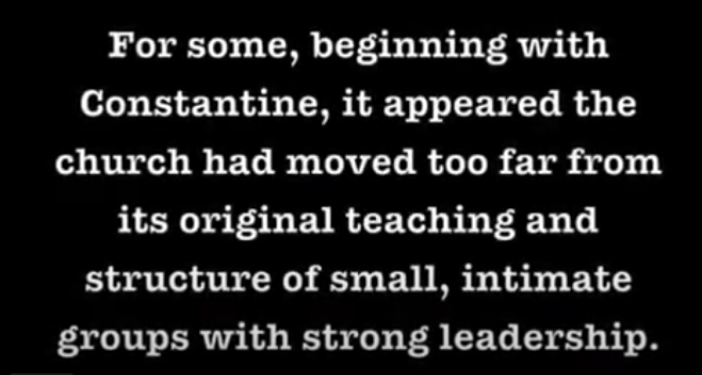
As I said, she didn’t read that, she flashed it on the screen. She did say, “The Neocatechumenal Way attempts to bring Catholics back to the original teachings and style of the early church.” Well, there’s a word for this: it’s called antiquarianism or primitivism—a perspective adopted by most Protestants, and we’ll discuss it a little bit further in a few minutes.
What I want to do now is let’s see if these views of this young lady correspond to what Kiko Argüello teaches and to what the “smart men” around Kiko Argüello say.
What does Kiko teach?
So Kiko teaches:
“The process of desecularization [dechristianization], the divorce between Christianity and life, comes from the fact that natural religiosity has infiltrated Christianity. In order to understand how this has happened, we shall draw a diagram of the history of salvation.”
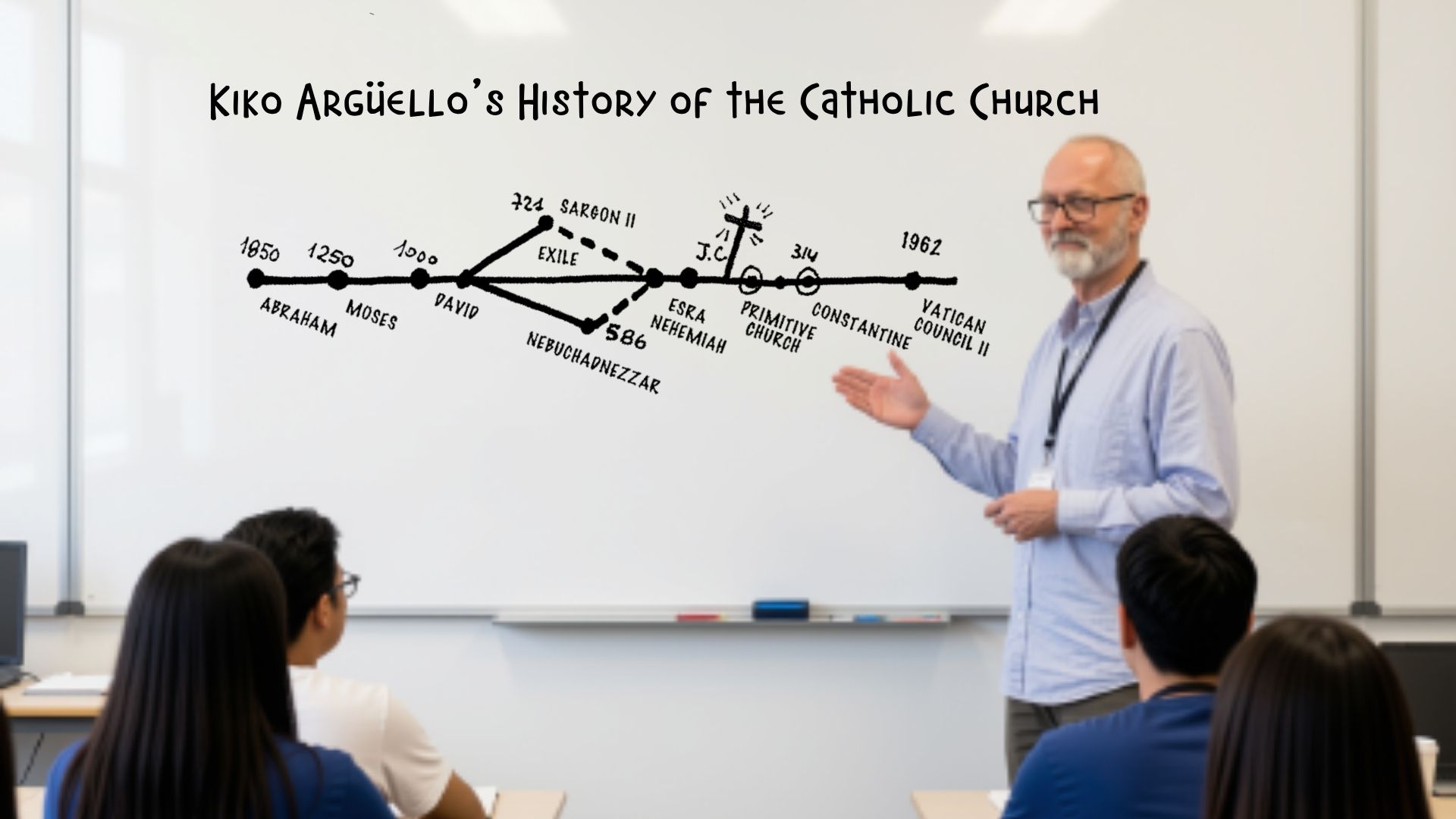
Let’s look at that diagram. Here is Kiko Argüello’s diagram of salvation history—a timeline taken from page 53 of the first volume of the Neocatechumenal Catechetical Directory, otherwise known as Guidelines for Teams of Catechists.
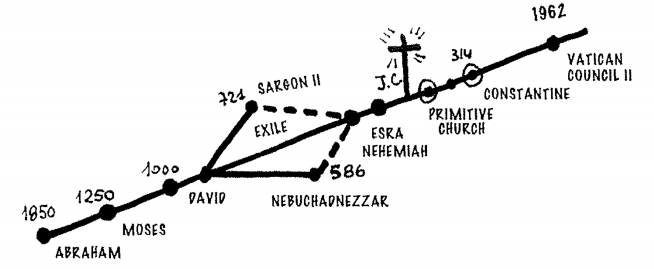
This is the diagram he uses to explain how natural religiosity—which we’ll soon see means paganism—infiltrated Christianity. And like any timeline, we should read this from left to right, and one can see that church history starts from the figure of the cross, near a little off-center. And we’re going to zoom in on that part of the timeline first.
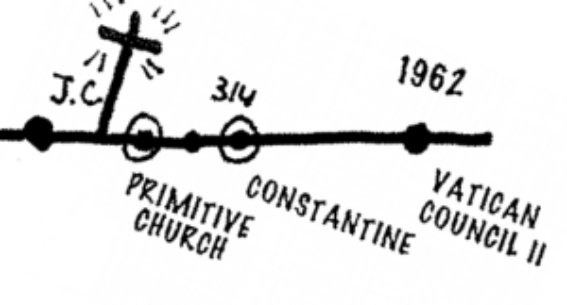
There it is. What do you think? Did Kiko miss anything with church history? He’s got the beginning in there, he’s got our Lord’s Cross, he’s got no reference to Pentecost when the church began, and he’s got the Emperor Constantine and the approximate date for the Edict of Milan, which legalized Christianity. And I’m glad he thought to include the Second Vatican Council.
But what’s in between Emperor Constantine and the Second Vatican Council? Nothing. Absolutely nothing. Does this strike you as strange? What about any of the other 20 ecumenical councils? The Council of Nicaea, which we mentioned before, and the Council of Constantinople, which were where the heresy of Arianism was finally turned back after sweeping through the church? Or the Council of Trent, which addressed the problems at the root of the Protestant revolt? No, they’re all missing. And people, why aren’t any of the great doctors of the church listed? St. Augustine, St. Thomas Aquinas, or how about the two mendicant friars who shook up the church and brought great renewal to it, St. Dominic and St. Francis? Or the great mystics like St. John of the Cross or St. Teresa of Avila, to name just two?
Kiko continues:
“But there comes a historical moment in which the Emperor Constantine promulgates peace for the church. These masses enter the church with all their natural religiosity, with all their religious schemes. And whereas at first there had been a catechumenate of three to four years to enter the church—a catechumenate that was an initiation into the faith—now this catechumenate could no longer be done because people entered en masse. Then what they do is to gradually Christianize the pagan religious schemes that people have.”
Well, Constantine was the Roman emperor from AD 306 to 337, and he was the first Roman emperor to convert to Christianity, although he was only baptized on his deathbed by an Arian bishop. And with the emperor of the East, he proclaimed the Edict of Milan, which legalized Christianity in the Roman Empire. And he summoned the First Council of Nicaea, mentioned by the young lady, in 325 AD, which produced the Nicene Creed that refuted Arianism and defined the dogma of the Holy Trinity. By the way, his mother was a saint, St. Helena (or Helen in English).
Let’s continue with Kiko:
“At the same time, they built enormous basilicas that brought elements of solemnity and grandeur into the liturgy. From this time on, the powerful light of the primitive church is covered over and obscured by elements of solemnity. The purity of the primitive liturgy gets covered over by overelaborate accretions.”
Kiko goes on to disparage liturgical elements such as the entrance rite with songs, the Introit, and the offertory procession. More Kiko:
“We are at a very historical moment in which the masses are leaving the church. Historically, this is very important. Just as in his time there was the opposite phenomenon where the nations entered the church after the peace of Constantine, using an expression of Congar, this parenthesis which was opened after Constantine is beginning to close today.”
Yves Congar,O.P.
He mentioned Yves Congar, who is a French theologian and Dominican—that’s the Order of Preachers. Congar was a peritus, that is an expert, at the Second Vatican Council from 1962 to 1965, and he was made a cardinal, actually, in 1994. In Congar’s theology, the concept of the “Constantinian parenthesis” refers to a period of time 16 centuries long where the Catholic Church was deeply intertwined with state power and juridical structures, and this is a period that he argued closed at the Second Vatican Council. Congar viewed this era not as the permanent, definitive state of the church, but as a temporary parenthesis in salvation history.
So Congar taught that after Constantine, the church increasingly adopted the structures, language, and symbols of the Roman Empire. Bishops acquired civil jurisdiction, official titles, insignia, and status resembling state dignitaries. The liturgy moved from household gatherings into solemn public and sometimes imperial forms, incorporating court ceremonial and hierarchical terminology. And Congar argues that this produced a top-down or hierarchical model of the church.
By the way, before I go on, I should say it is true that a healthy understanding of church history should include acknowledging the sins of its members, clergy, and popes, and also including the cataclysmic split of the churches of the East and the West, and the Protestant revolt.
So that Kiko Argüello and Carmen Hernández, the founders of the Neocatechumenal Way, were influenced by Congar cannot be denied after one looks at how Kiko drew the timeline of salvation history. In its original Italian catechesis, note on the Italian version, the literal parentheses between Constantine and the Second Vatican Council have nothing inside them.
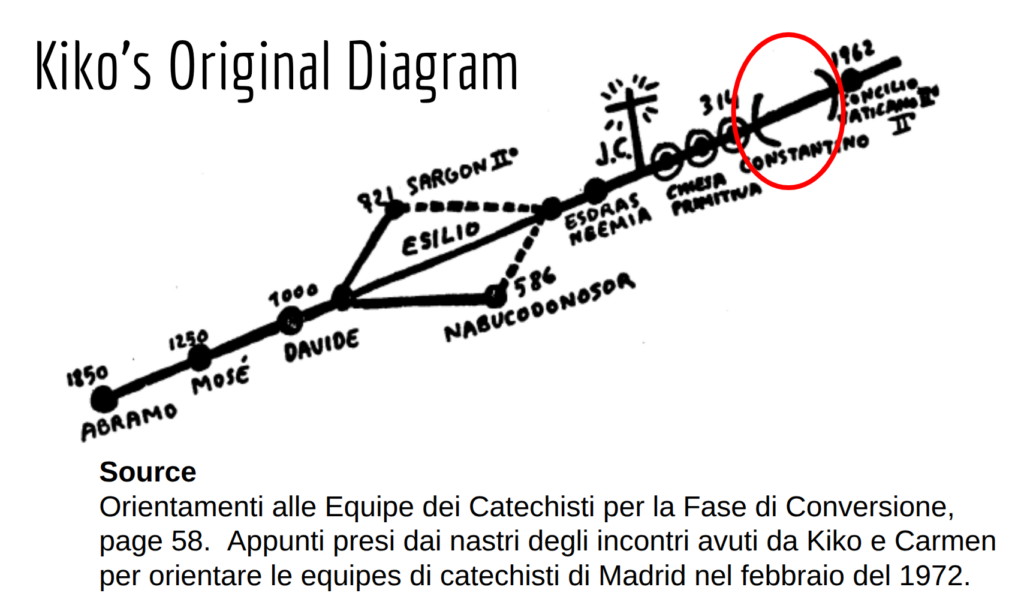
And there’s more. Thus far, I’ve only concentrated on the history of the church and neglected the left side of Kiko’s timeline. Taken together, Kiko is describing his version of salvation history and trying to make a point while doing so. Let’s look at this side now.
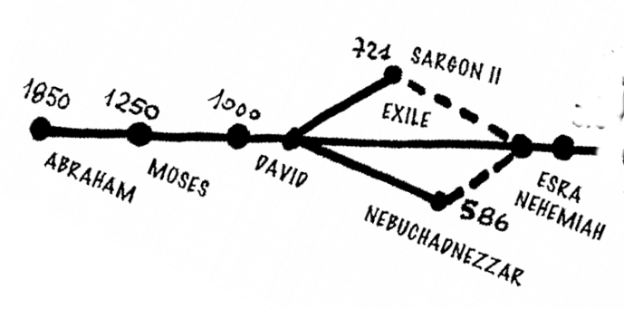
So we’re back to the left side of the diagram, and there we have basically the Old Testament. There are a few interesting things to notice about this side of the picture. For one, he doesn’t start out with the Fall of Man and Adam, as you would expect, but with Abraham. He does have Moses and David in there, as he should, but he leaves out a lot in favor of the Assyrian and Babylonian Exiles. Why is that? You see the names of two pagan emperors on Kiko’s timeline.
Sargon II was the Assyrian king who conquered the northern kingdom of Israel, deporting thousands of Israelites to Assyria and importing thousands of pagans into what was the northern kingdom of Israel. Nebuchadnezzar was the Babylonian king who conquered Judea several generations later and deported thousands of Judeans to Babylon.
Now, the exiles were certainly part of salvation history and important, but why do they dominate Kiko’s timeline? Well, notice that Ezra and Nehemiah are listed. Ezra and Nehemiah were the priests and laymen who rebuilt Jerusalem after the exile and reestablished proper temple worship and the practice of Mosaic Law in Jerusalem.
Of course, this was good, but their presence on the timeline and the emphasis on the exile and the pagan emperors, I believe, are supposed to complement the Constantinian parenthesis—that time of malaise, according to Kiko, between Emperor Constantine and the Second Vatican Council, and Kiko’s arrival, by the way. So there’s a deliberate parallelism here between the exile and the Constantinian parenthesis.
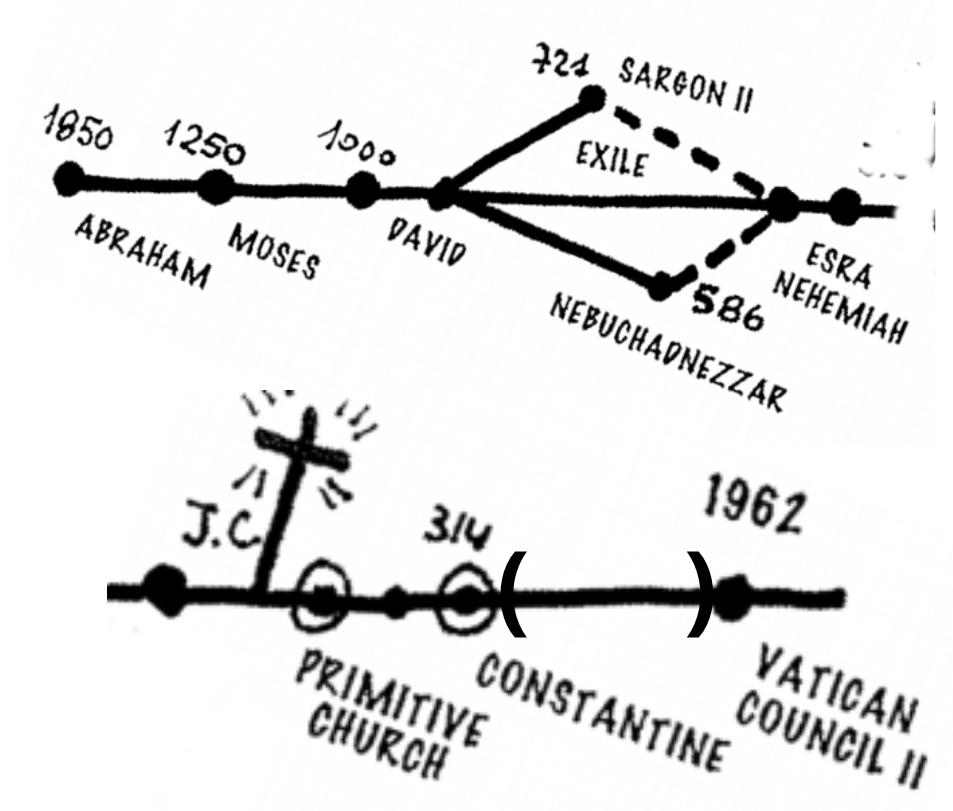
Let’s put the two sides of the timeline, let’s stack them to see this parallel. So the exiles and the Constantinian parenthesis are seen to be parallel, each initiated by pagan emperors. We got Sargon and Nebuchadnezzar, and then Constantine. Could he be trying to say that Ezra and Nehemiah rebuilt Judaism—those are Kiko’s words—and that Kiko will rebuild the church?
Redemptoris Mater Professors
So I presented the view of one young member of the Neocatechumenal Way earlier. Now let’s look at a document written by some other followers of the Neocatechumenal Way: Redemptoris Mater professors. And they wrote this in a document that was introducing a theological journal or a journal dedicated to the cultural theorist René Girard:
“Since before the Foundation of the world, YHVH was showing a path to man to protect him from self-destruction , which foreshadows the apocalypse, that possibility that God could not avoid without dehumanizing us. The first attempt was the path of religion, through sacrifice, to control the arbitrary violence of men. After that failed attempt , came Christianity, and while it has been contaminated by archaic religious systems and showed two faces, it always clearly presented the alternative face, that of Christ.”
So Redemptoris Mater professors, at least the two that wrote this and actually served in our diocese, believe that after Constantine, Christianity was contaminated by archaic religious systems.
Kiko’s Architects
Next we’ll go to Kiko’s chief architects, Maurizio Bergamo and Mattia del Prete, writing in a book that was written in Italian, the English title of which is Celebratory Spaces: The Architecture of the Church. They have something similar to say, and these are the men that have been responsible for doing Neocatechumenal renovations of many of the parish churches that they control throughout the world. They say:
“It is typical of natural religiosity, from which came the great masses which expanded the church [establishing] with God a relationship in which you offer things to appease him and to obtain benefits: sacrifices, lamps, money, in some cases human life itself. Israel also for a time had this kind of sacrificial worship; it remains today.”
So in their book, they say that the Second Vatican Council indicated that a sacrificial mentality had to be removed or diminished in the church, and they’re going to change the architecture accordingly.
And at this point, I have to mention that Congar, whom I mentioned before, did not downplay the sacrificial aspects of the Eucharist like Kiko and his followers do, that idea was part of the work of Congar’s contemporaries, Edward Schillebeeckx and Hans Küng.
A Summary
So this seems to summarize the Neocatechumenal view of the history of the Catholic Church that’s filtering down to members of the Neocatechumenal Way through their catechists :
- The church was negatively affected by Constantine.
- The period of church history between Constantine and the Second Vatican Council was a detour from original and authentic Christianity.
- Ecumenical councils like the Council of Nicaea are spoken of in pejorative terms, and it also includes the Council of Trent, and you know there were 20 such councils other than the Second Vatican Council.
- Christianity was infiltrated by natural religiosity or contaminated by archaic religious systems, that is, a “sacrificial mentality” brought by the masses that entered after Constantine.
- The church Christianized pagan religious schemes.
- After Constantine, in Christianity, which was protected by the emperor, worship became very ornate and full of pomp and grandiose songs and music, and bloated with accretions, according to Kiko.
- The Second Vatican Council is contemporaneous with a massive exiting of secularized Catholics from the church, and that denotes the end of the Constantinian parenthesis, and the Neocatechumenal Way will rebuild the church according to its original form.
Now, these views expressed by members of the Neocatechumenal Way under the influence of its founders and catechists are properly called antiquarianism or primitivism, and it was soundly rejected by Pope Pius XII in his 1947 encyclical Mediator Dei.
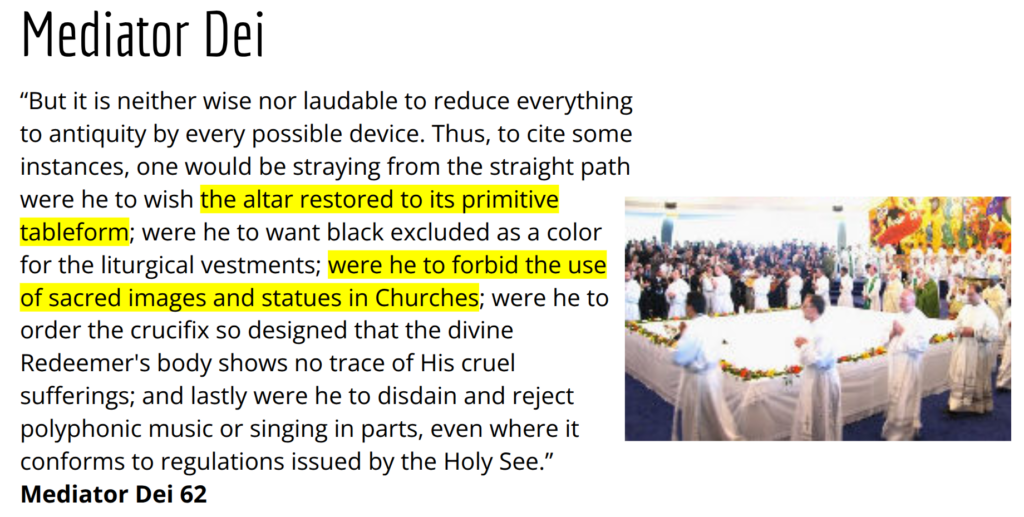
In his 1947 encyclical Mediator Dei, Pope Pius XII soundly repudiated the type of antiquarianism espoused by the Neocatechumenal Way, and he said that efforts to return to the original days of Christianity were neither wise nor laudable, and recalled bids to revive antiquarianism to be exaggerated and senseless. But remember, Pope Pius XII lived on the other side, inside the Constantinian parenthesis from Kiko’s view, so I guess his teaching can be ignored, right?
The fact is that our Lord guaranteed that the gates of hell would not prevail against his church. Catholics can acknowledge the past sins of the church’s members and leaders, even corrupt popes during the Renaissance, but should always acknowledge the action of the Holy Spirit in his church, especially during the time between Constantine and the Second Vatican Council.